

With the launch of the QV-E yesterday, Perodua finally has an entry into the burgeoning electric vehicle market, priced significantly under the RM100,000 mark. But the headline RM80,000 figure does not include the battery, which has to be leased separately – the first EV sold in Malaysia in which this is the case.
UPDATE: Perodua has released a product disclosure sheet for its battery leasing service, containing more details and some significant changes to what was originally announced. The article has been edited with new information.
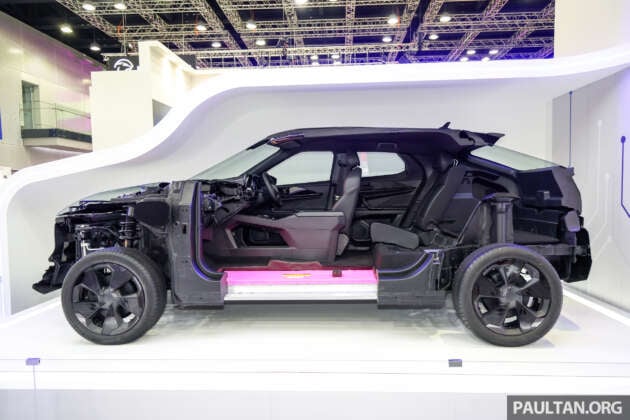
Perodua is instead introducing local customers to the battery-as-a-service (BaaS) concept, which it claims will solve issues with battery degradation and, ultimately, resale value – two of the biggest pain points of EV ownership. The cost of the lease, with a fixed contract period of nine years (you can’t get a longer or shorter tenure), is RM275 per month excluding the 8% sales and service tax (SST), the latter putting the total figure to just under RM300.
However, you will also need to come up with three months’ advance payment upon signing the least agreement, costing RM825 excluding SST, or nearly RM900 with SST. This amount will be used to either cover the final three months of the lease or settle any outstanding lease payments in case of an early termination, with any excess refunded to you. The upshot is that you will effectively need to pay for four months in lease payments up front, with an initial outlay of almost RM1,200.


Payments are made on or before the fifth of each month, with a fee of 1% per year being charged for every missed or late payments. Perodua may disable the car’s startup or the battery’s functionality if users miss payments by two months, and the lease agreement will be terminated after month three, after which the company will begin the battery recovery process.
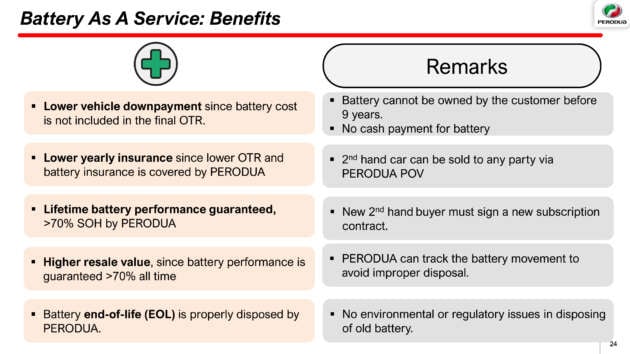
Perodua claims the Shariah-compliant BaaS scheme guarantees the QV-E’s future resale values, assuming the body itself (and the motor and associated components) holds its value. This is because the national carmaker will handle any and all maintenance related to the battery, including replacing the pack entirely if its state of health (SoH) drops below 70%.
The lengthy lease period also ensures that your battery (or rather, Perodua’s battery in your car) will remain in good condition for a very long time, being a year longer than a typical eight-year battery warranty. Crucially, the lease is uncapped in terms of mileage, rather than being limited to the usual 160,000 km as per a warranty. We should point out, however, that you will not be able to use the QV-E as an “e-hailing” (such as Grab) or delivery car, as this is prohibited under the lease contract.

With regards to resale values, Perodua says the lease contract will make owning a used QV-E more desirable. On a typical EV, the general perception (it doesn’t really matter if it’s a right or wrong one; it’s there) is that the battery is a “ticking time bomb” – in that it’s only a matter of time before its SoH degrades beyond a point in which it continues to be usable.
The worry is that a used EV will only have a few years of use left before the battery needs to be replaced – and if the replacement falls outside of the warranty period, the owner will be burdened with an enormous bill. A seven-year-old EV that gets put up for sale, for instance, will only have a year of battery warranty left; beyond that, the new owner would have to replace a faulty or degraded battery at their own expense.
The used car selling price would thus need to factor in the cost of a potential replacement, driving it to the ground. This is one of the main reasons why the demand for pre-owned EVs is low, and why even nearly-new examples can be bought at half their retail price.
No such worry for the QV-E – the new buyer will simply have to sign a new lease to effectively be guaranteed a further nine years of worry-free motoring. This should, in theory at least, increase buyer confidence in the car, leading to higher used demand and, thus higher resale values.
In addition, having the batteries under its own control means Perodua will be able to keep a close eye on its inventory and dispose of every spent or damaged battery safely and sustainably, improving the car’s eco-friendly credentials.
This goes hand-in-hand with the “battery passport” that Perodua is introducing, in line with the standard implemented by the ministry of investment, trade and industry (MITI) and the Malaysia Automotive Robotics and IoT Institute (MARii) last month. This, according to the department of standards, provides a “comprehensive digital record of an EV battery’s life cycle, from production to disposal,” per Malay Mail.
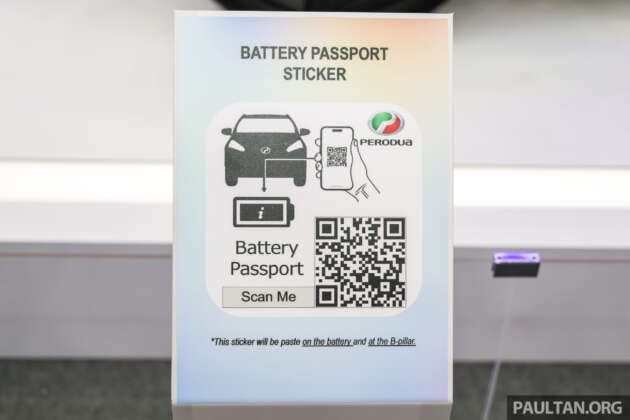
The tracking of each battery’s lifecycle extends to the included GPS tracker, which enables Perodua to detect if a battery has been detached from the car was originally installed on, or if the said car has been abandoned. In such a situation, the company can locate the missing battery and send a team out to retrieve it.
As you can expect, there are also downsides to the BaaS approach. For one, the RM80,000 sticker price can lull buyers into thinking that the QV-E is more affordable than it actually is. Taking into account a 10% downpayment and an interest rate of 2.5% per annum, buyers can expect to pay around RM1,120 per month (RM820 for the body) on a nine-year loan, RM1,310 per month (RM1,010 for the body) on a seven-year loan and RM1,650 per month (RM1,350 for the body) on a five-year loan.
These figures are akin to financing a car costing around RM100,000, and the QV-E should be thought of as such – not as an “RM80k car”. As one reader put it, the circa-RM300 monthly lease is more than the fuel bill of an equivalent petrol model, and the buyer would still need to pay for charging.


Another disadvantage is that any necessary battery replacements – whether it’s been damaged by an accident or through the lessee’s negligence or misuse – will require the owner to sign a new nine-year contract. The exception is when the battery exhibits a manufacturing defect or fault, upon which it will be replaced under warranty without altering the original lease term.
The QV-E counters with expected lower maintenance costs, as it does away with expensive engine and transmission oil changes. And while the usual savings in EV service and running costs tend to be more than offset by the massive outlay of an eventual battery replacement (although a battery that is depleting faster than normal would typically be covered by a lengthy battery warranty anyway), this is simply not the case for the Perodua. In effect, you are paying for a replacement with the lease.
Also, offering the body separately from the battery means that the loan will only be calculated based on the RM80,000 amount, meaning that it should be easier to gain approval from the bank. The instalment and the lease payment are paid to the bank in one lump sum – the bank will split the amount and pay Perodua on your behalf, so there’s no need to make two separate payments.
If the loan tenure ends before the lease expires, subsequent lease payments will have to be made either through Perodua’s P-Circle app manually, or via a standing instruction through participating banks. One thing of note is that you will never own the battery outright. Even after the conclusion of the lease contract, the battery still belongs to Perodua, although you’ll no longer have to pay the RM275 free and can continue to use the battery as long as you want.
This may not matter much in the grand scheme of things, but it’s still something you should keep in mind. You can, of course, also sign a new contract, get a new battery and continue the lease for another nine years, ensuring that the battery is still maintained at a good SoH.
Selling the QV-E secondhand is also not such a straightforward affair. Within the lease period, the car can only be sold through POV, Perodua’s certified pre-owned vehicle service. This is the only way that the new buyer can legally become the lessee of the car’s battery. You cannot sell it directly to a private buyer, a used car dealer or even larger marketplaces like Carro or Carsome.
Obviously, Perodua cannot control the manner in which owners ultimately sell their car through, but it’s worth pointing out that paying for a lease that’s under someone else’s name is an offence, just like in a sambung bayar arrangement. Controlling the secondhand QV-E market through POV is another way in which Perodua aims to guarantee future resale values.
And yes, even if the car is sold with a perfectly functional battery, the new buyer will have to sign a new nine-year contract and receive a new battery; there is no way for them to inherit the existing contract and battery. As mentioned, the rationale is that by changing the battery each time there’s a change in owner, the car will always be guaranteed to work for another nine years, improving resale values.
Of course, you can then make the argument that as there is no way to shorten the lease period beyond the standard nine years – and especially if resale values end up being as strong as Perodua says they’ll be – there would be little incentive to buy a slightly cheaper used QV-E instead of simply plumping for a new one. But that’s a story for another day.
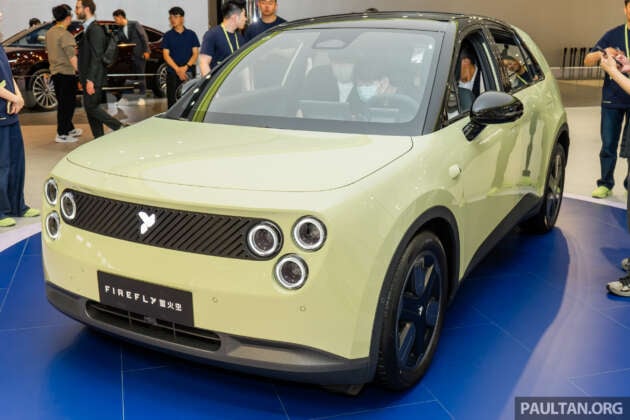
Perodua may be the first carmaker in Malaysia to provide battery leasing, but there are other companies that offer a similar service in other markets – most notably, Nio in China. Its affordable Firefly sub-brand, for instance, offers a subsidised version of its eponymous hatchback starting from just 79,800 yuan (RM46,600), in return for a monthly lease payment of 399 yuan (RM230) for a smaller 42 kWh battery (QV-E 52.5 kWh).
No lease period could be found, but the biggest, most crucial difference is that the car can indeed be purchased including the battery, costing 119,800 yuan (RM70,000). That means the car body gets a 40,000 yuan (RM23,400) discount without the battery, which is about in line with what Perodua is offering.
So that’s a detailed look at the BaaS scheme for the QV-E, and why Perodua thinks it makes sense for the Malaysian market. What do you think – will it flop, or is there a chance it will actually be a success? Sound off in the comments.
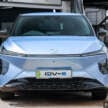
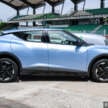
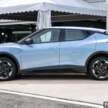
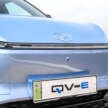
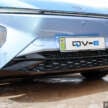
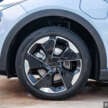
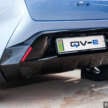
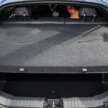
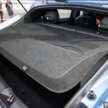
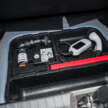
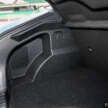
GALLERY: Perodua QV-E




















































Looking to sell your car? Sell it with Carro.










 Jack
on
Jack
on 

 Dong Gor
on
Dong Gor
on  DonkeyKong
on
DonkeyKong
on  P2
on
P2
on  P1
on
P1
on  Celup King
on
Celup King
on  Maverick
on
Maverick
on  Akai
on
Akai
on  paanjang16
on
paanjang16
on  FrankC
on
FrankC
on  ioma
on
ioma
on  RM275 IQ tax
on
RM275 IQ tax
on  EVs
on
EVs
on  Perodua FOMO EV
on
Perodua FOMO EV
on  Gary
on
Gary
on  costway coldcool
on
costway coldcool
on  LoneOpinion
on
LoneOpinion
on  Santok Singh
on
Santok Singh
on  Thed
on
Thed
on  Rn
on
Rn
on  Harz
on
Harz
on  newme
on
newme
on  Haiya
on
Haiya
on  Mr Saitama
on
Mr Saitama
on  Yes
on
Yes
on  opmanmy
on
opmanmy
on  4GR-FSE
on
4GR-FSE
on  Najib
on
Najib
on  Jojo
on
Jojo
on  WOW
on
WOW
on  byd salesman
on
byd salesman
on  FoolMeOnce
on
FoolMeOnce
on  kogila
on
kogila
on  prolever
on
prolever
on  Steve
on
Steve
on  Skiddy dibidooo
on
Skiddy dibidooo
on  Eowa
on
Eowa
on  Ongtk
on
Ongtk
on  alibaba
on
alibaba
on  CarGuy
on
CarGuy
on  malaysians oh malaysians
on
malaysians oh malaysians
on  Unker
on
Unker
on  Rks
on
Rks
on  Jonathan Lee (Member)
on
Jonathan Lee (Member)
on  mee too
on
mee too
on  failure
on
failure
on 


AI-generated Summary ✨
Comments express widespread concern and disappointment with Perodua's battery leasing (BaaS) strategy for the QV-E, viewing it as unfair, costly, and restricting resale value. Many believe the RM300/month fee is high and liken it to a postpaid phone plan or installment, making EV ownership less attractive. Critics worry about the long-term commitments, remote tracking, and potential for increased costs if the subscription rises. Several feel the leasing model diminishes ownership freedom, lowers resale value, and may hinder EV adoption in Malaysia, with some suggesting the company should include the battery in the initial price or offer an all-in option. Overall, comments are skeptical of BaaS's practicality and see it as a strategic misstep that could alienate customers.