
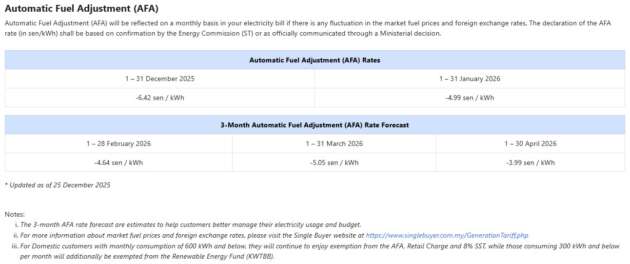
Tenaga Nasional Berhad (TNB) has stated that the Automatic Fuel Adjustment (AFA) rate for the month of January 2026 is -4.99 sen/kWh from -6.42 sen/kWh in December 2025. The AFA, which is set by the Energy Commission (ST), replaces the previous Imbalance Cost Pass-Through (ICPT) and is automatically calculated as either a surcharge or discount of up to 3 sen/kWh depending on fuel prices – this is revised monthly, with any larger changes (beyond 3 sen) requiring cabinet approval.
Introduced as part of TNB’s Electricity Tariff Restructuring that took effect from July 1, 2025, the AFA is one of five components or “charges” used to calculate your electricity bill. Here’s the overview:
- Generation charge: 27.03 sen/kWh for total consumption of 1,500 kWh and below per month or 37.03 sen/kWh for total consumption more than 1,500 kWh per month. This covers the actual cost of generating electricity from power plants.
- Capacity charge: 4.55 sen/kWh. This covers the cost of maintaining sufficient electricity supply capacity.
- Network charge: 12.85 sen/kWh. This covers the cost of operating and maintaining the grid and the local network to deliver electricity.
- Retail charge: RM10/month; waived for total consumption of 600 kWh and below a month. This is a fixed cost for metering, billing and customer service.
- AFA rate: -4.99 sen for the month of January 2026; waived for total consumption of 600 kWh and below a month.
You can use our TNB Bill Calculator tool to get a rough estimate on how much your electricity bill will be for the month. Essentially, if you use over 1,500 kWh a month, you add the generation, capacity and network charges (totalling 54.43 sen/kWh) to retail charge (RM10) and the AFA rate (-4.99 sen/kWh discount for January 2026).
Alternatively, if your usage is below 1,500 kWh a month, it’s 44.43 sen/kWh plus the retail charge and AFA rate. For total consumption of 600 kWh and below a month, it would only be 44.43 sen/kWh – retail and AFA charges are waived.


Here’s a list of the monthly AFA rates so far:
- July 2025: 0.00 sen/kWh
- August 2025: -1.45 sen/kWh
- September 2025: -1.10 sen/kWh
- October 2025: -6.50 sen/kWh
- November 2025: -8.91 sen/kWh
- December 2025: -6.42 sen/kWh
- January 2026: -4.99 sen/kWh
Domestic consumers who use less than 1,000 kWh a month can enjoy a discount called ‘Insentif Cekap Tenaga’ or ‘Energy Efficiency Incentive’. The discount provided is relative to consumption (the more the usage, the lesser the incentive), with the maximum discount being 25 sen/kWh.
Domestic users that have smart meters also have option to enter the Time of Use (ToU) scheme, allowing them to change their electricity usage pattern and take advantage of lower tariff rate during off-peak hours to enjoy savings on their monthly bill.
The scheme has two time zones, with off-peak timings being from 10pm to 2pm from Monday to Friday and throughout the day (24 hours) for weekends. Peak hours are from 2pm to 10pm on weekdays. Here are the energy charges under this scheme:
For usage of 1,500 kWh and below per month
- Peak tariff: 28.52 sen per kWh
- Off-peak tariff: 24.43 sen per kWh
For usage above 1,500 kWh per month
- Peak tariff: 38.52 sen per kWh
- Off-peak tariff: 34.43 sen per kWh
Looking to sell your car? Sell it with Carro.





Before June 2006, TNB’s average electricity tariff was at 23.50 sen/kWh.
In June 2006, it increased to 26.32 sen/kWh.
In July 2008, it increased to 31.31 sen/kWh.
In March 2009, it increased to 32.50 sen/kWh.
In June 2011, it increased to 33.54 sen/kWh.
In January 2014, it increased to 38.53 sen/kWh.
The BN gomen was in charge during those years.
Under Madani apa pon naik. Except rakyat Sabah has given them telor. Time for rakyat Peninsular to give them telor too.
In Sabah, there is no TNB because they already have SESB. Therefore, Sabahans are not affected by TNB rates.
Why don’t you go back to British rule? Everything was much cheaper then.
the average income then was much lower too.
Buying a car supposed to be enjoyable.
Ni tak… kira bil letrik, kira jarak ntah sampai ke tak, then check mana ada charger outstation. It supposed to make your life easier.
Sama je with petrol/diesel vehicles. You look at fuel price (which Paul Tan publishes periodically), you also look at the vehicle fuel consumptions of the said vehicle. And you definitely look for available petrol stations especially during festive seasons.
Difference is EVs has much lower running cost than ICE and can charge from home and might be free if you have solar PV under NEM scheme.
these are all trivial issues that a 5 year old should be able to handle, let alone a educated white-collar T20 civilized adult. because EVs are mostly bought by educated white-collar T20 civilized adults
buying a normal car need to think about normal wear and tear maintenance – change spark plugs, engine oil, gearbox oil , filters, timing belt, etc. do these make your life easier.
thsoe that you mentioned are minor issue that a 5 year old would be able to handle.
Habis lah EV