

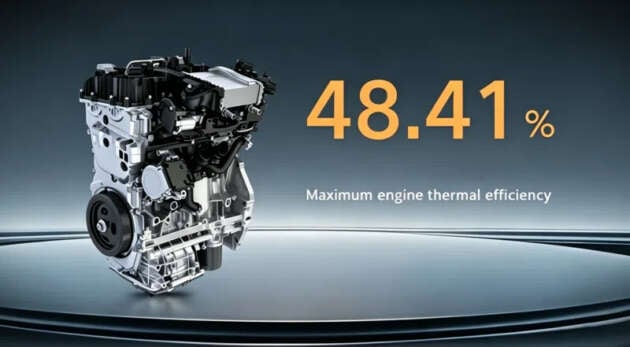
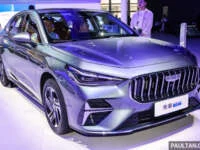
Geely has launched a hybrid system called i-HEV that will make its way to models such as the Preface (Xingrui), Monjaro (Xingyue L), Emgrand (the previous gen of which we know as the Proton S70) and Boyue (the previous gen of which spawned the Proton X70) starting this year, Car News China reports, citing Autohome and IThome.
i-HEV involves a dedicated hybrid engine (1.5, 1.5TD or 2.0TD from the BHE family; TD means turbo direct-injected) with a claimed 48.4% thermal efficiency (higher than the latest Galaxy Starship 7’s 47.26% and our Proton eMas 7 PHEV’s 46.5%) that Geely says is among the highest in mass production. The 11-in-1 electric drive unit gives you 313 PS, enabling a 1.8-second 0-30 km/h (yes, not 0-100 km/h) time.
Indeed, the focus appears to be more on efficiency than outright performance – Geely says AI-based energy management contributes towards a Guinness-certified 2.22 litres per 100 km (45 km per litre) combined, which was achieved with an Emgrand i-HEV in a highway test, Reuters reports. But the practical numbers are much less astronomical – 3.98 litres per 100 km (25 km per litre) for the Preface i-HEV and 4.75 (21 km per litre) for the Monjaro i-HEV, both WLTP.
Having conquered EVs and to a certain extent PHEVs, it seems Geely’s now setting its sights on the Japanese HEV establishment. Will we see Protons with this i-HEV system any time soon?



Good, very good. Destroy the greedy Japanese legacy vermin car companies. They have been sucking the people dry with mediocre “uplifts” for years now.
You do realise the Japanese cars are priced at such to protect P1 & P2 right. Don’t blame any legacy car companies. Blame yourself for being poor.
Guinness-certified 2.22 litres per 100 km
So nice, bringing in for our D segments?
read properly its actually 25 km per litre . on par with the toyota prius.
Geely Preface i-HEV 25km/L, it’s a much larger car than the compact Prius though.
And 30 years behind time.
If the Geely’s hybrid system is robust and won’t breakdown in 5 or 10 years, Toyota will definitely pee in their pants.
There is evidence that many Plug-in Hybrid Electric Vehicles (PHEVs)—including EREVs (Extended-Range Electric Vehicles)—in China are achieving high mileage, often exceeding 300,000 km, particularly when used in high-intensity applications like taxi services
A car with bigger battery will make the car heavier and its bad from environment aspect including the mining to make the battery and even worst when it comes to disposal and recycling. Big battery means more money to spent in repairs.
Toyota standard HEV has the best balanced between both worlds. Why Toyota makes the PHEV then, it has to go with the market flow.
If you look up close, Toyota doesn’t have as many PHEVs or full BEVs. Just several models to fill up its catalogue @ showroom. It still believes HEVs are the way for the future.
the purpose of big battery is to achieve Zero Emissions in city and urban area, and this engineering solution was developed to fulfill legislated law.
but to achieve that , first consumers have to be disciplined to charge their battery frequently.
this is what Saga badly needed!!! if it can be integrated into Saga offering, i think they will have a good chance in philipine and also our local market.
Bring on Geely’s best offering fast! .. S70 too can benefit from it…
hopefully it can consume Ron 95 too.
why cannot consume ron95 ? you think a budget efficient car requires ron97?