
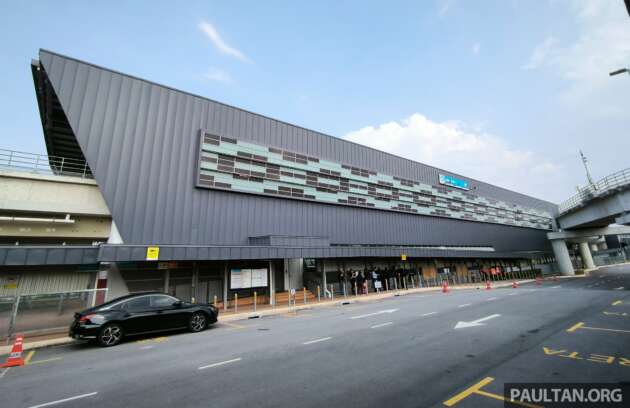
Prasarana is aiming to increase its average daily ridership to 1.7 million passengers by next year, by improving the reliability and availability of its rail and bus services, Bernama has reported.
The target is based on the company’s performance of having attained 1.3 million passenger trips a day on average last year, said Prasarana group chairman Tan Sri Mohd Nasir Ahmad.
“This increase in public transport usage has taken about 377,000 private vehicles off the road each day, preventing approximately 225,000 tonnes of carbon emissions throughout 2025,” he said.
Prasarana will continue to prioritise service reliability and availability to ensure its trains and buses remain the preferred mode of transport for commuters, and the group chairman is confident that the target is achievable with the opening of the Shah Alam Line last month, as well as the upcoming commencement of the Rapid Transit System (RTS) Link that will connect Johor Bahru and Singapore.


Meanwhile, as of June, four out of five Prasarana rail lines achieved their mean kilometres between failure (MKBF) targets, Prasarana president and group CEO Amir Hamdan said. The Ampang, Kelana Jaya and Sri Petaling lines each recorded one million MKBF, while the Monorail Line achieved its target of 150,000 MKBF, he said.
Earlier this month, transport minister Anthony Loke said that the rail service in the Klang Valley has seen fewer disruptions compared to previous years, with the number of train breakdowns having dropped significantly since 2022.
“As for our bus services, we remain on track to fully integrate electric buses into our fleet by 2027. We will deploy the final batch of diesel buses to replace ageing vehicles in stages, while upgrading 11 depots with charging infrastructure to support electric bus operations,” Amir said.
“By September, our first electric buses will begin serving the public, marking another important milestone in our journey towards cleaner and more sustainable mobility,” he said.


Who owns Prasarana? KWSP.
Who owns KWSP? MOF.
Who the boss of MOF? PMX.
TQ PMX for giving the people of Malaysia good rail transport.
It’s a good thing that public transport is moving in the right direction in Malaysia, but I still feel that station placement and connectivity is still quite poorly designed. There might be some level of political issues that the government couldn’t settle with the private sector, which might have contributed to poor placement, which is a sad thing. Some stations along LRT3 is placed in areas where you can’t really access the stations by any other means other than cars. Rapid on Demand looks to me like a very costly last mile solution. Cities should be more integrated with mass transit and it should be designed into the master plans rather than being added as an afterthought or mere marketing tool. Some new development claims to be “500m” from a station, but those are usually straight, imaginary lines on a map, and doesn’t account for the flight of stairs, cutting through busy roadways, and convoluted uncovered paths. The surrounding infrastructure needs to be more thoughtful, and the city planners should be more engaged with this rather than just “expediting approval”. Prasarana alone cannot meaningfully improve public transport beyond a point. City councils, the private sector, and maybe even local citizens need to be more involved with this.
Less disruption & more reliable eh?
Then why every now and then, theres news about train delay & even serious issues (malfunctioning doors, rail derailment)?
And buses are so unreliable, with no future concrete BRT plans? And poor pedestrian infrastructure (LRT3 MBSA).
Stop whitewashing and admit that service has been terrible. Get experts like Wan Agyl & Rosli Khan to design blueprint to reform the country’s Public Transport master plan.
If Rosli Khan is an expert, then I’m a master of PT