
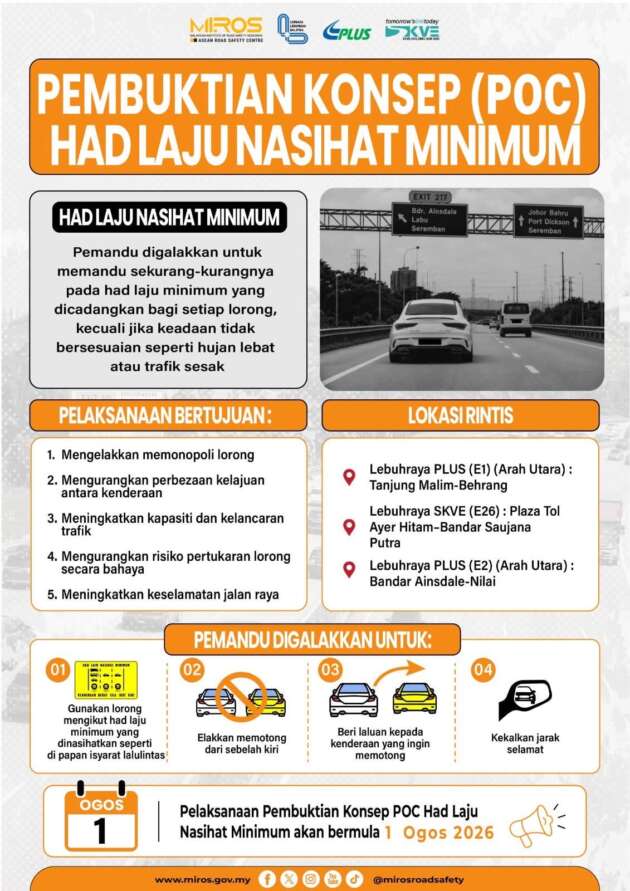
We’re all familiar with maximum speed limits, but how about a minimum? Starting today, August 1, the Malaysian Institute of Road Safety Research (MIROS) – together with the Malaysian Highway Authority (LLM), PLUS and SKVE – is running a proof-of-concept (POC) trial for minimum advisory speed limits on selected highway stretches, under the banner Had Laju Nasihat Minimum.
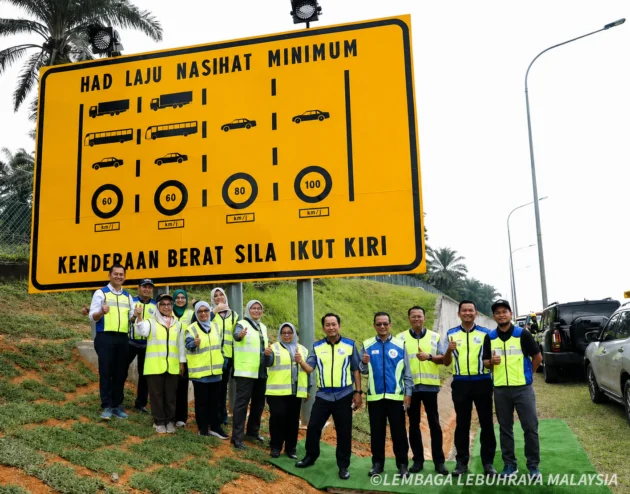
The idea is simple: each lane gets a recommended minimum speed, displayed on signboards, and drivers are encouraged to travel at least at that pace for the lane they’re in – unless conditions don’t allow it, such as in heavy rain or congested traffic. In other words, if you want to cruise slowly, keep left; the further right you go, the faster you’re expected to flow.
Note the word “advisory” – this is a trial of guidance signage, not a new enforceable speed floor. MIROS lists five objectives for the exercise:
- Preventing lane monopolising (lane hogging)
- Reducing the speed difference between vehicles
- Increasing traffic capacity and flow
- Reducing the risk of dangerous lane changes
- Improving overall road safety
The POC runs at three pilot locations:
- PLUS E1 (northbound): Tanjung Malim-Behrang
- SKVE E26: Ayer Hitam toll plaza-Bandar Saujana Putra
- PLUS E2 (northbound): Bandar Ainsdale-Nilai
Through the trial, drivers on these stretches are encouraged to:
- Use the lane that matches the advisory minimum speed shown on the signboards
- Avoid overtaking from the left
- Give way to vehicles that wish to overtake
- Maintain a safe following distance
“Jangan jadi punca trafik terganggu” – don’t be the cause of disrupted traffic – is how MIROS put it in its announcement, and that framing is the whole point of this exercise.
Why slow driving in the wrong lane is dangerous
It sounds counter-intuitive, but driving slowly on a highway – in the wrong lane – doesn’t make anyone safer. Road safety research has long shown that the danger on highways isn’t absolute speed alone, but speed variance: the bigger the difference between the fastest and slowest vehicles sharing the same stretch, the higher the crash risk. A car doing 70 km/h in the right lane of a 110 km/h highway is a moving obstacle that every single vehicle behind it must react to.
The research on this goes back decades. The classic reference is the “Solomon curve” – US researcher David Solomon’s 1964 study of around 10,000 crash-involved drivers, which plotted crash involvement against deviation from the average traffic speed and found a U-shape: drivers travelling near the mean speed had the lowest crash rates, with risk rising for those going faster and, in his data, rising even more steeply for those going slower. Later work tempered the slow side of that curve – a 1970s reanalysis showed many of Solomon’s “slow” crashes involved vehicles slowing to turn rather than cruising slowly – but a 1968 follow-up by Julie Cirillo found the same U-shaped pattern on American Interstate highways, where turning traffic isn’t a factor. Economist Charles Lave’s oft-quoted 1985 finding distilled it further: fatality rates tracked speed variance, not average speed. Modern reviews land on a balanced position – higher absolute speeds raise crash risk, and so do large speed differences between vehicles on the same carriageway, because differentials force the braking, lane-changing and undertaking manoeuvres where crashes happen.
And how do they react? Each following driver has to brake, then change lanes – often to the left, into the blind spot-riddled space lane hogs force them into – then accelerate past and merge back. Every one of those manoeuvres is an opportunity for a misjudgement, and the more cars that have to perform them, the more opportunities stack up. The lane hog experiences none of this drama; they simply motor on, oblivious, while generating risk for everybody else. We’ve seen where this leads – a slow car drifting into the fast lane caused a rear-end collision in one widely-shared local incident.
There’s a traffic-flow cost too. Braking waves propagate backwards through dense traffic – the “phantom jam” effect, famously demonstrated in a 2008 Japanese experiment in which drivers asked to simply maintain a constant speed around a circular track spontaneously produced stop-and-go shockwaves. One slow vehicle in the overtaking lane can likewise congest a highway for kilometres behind it. That’s why “increasing capacity and flow” sits alongside safety in MIROS’ objectives: lane discipline isn’t just about courtesy, it’s about how many vehicles a highway can safely carry.
It’s worth remembering that lane hogging is already an offence in Malaysia, carrying a fine of up to RM2,000 – the middle and right lanes are legally for overtaking, with the left lane the default cruising lane. Heavy vehicles are separately banned from the right lane on highways. What the MIROS trial adds is the other half of the equation: not just “don’t camp in the fast lane”, but “if you are in it, keep up”.
To be clear, this isn’t a licence to speed – the advisory minimums sit below the posted maximums, and the guidance explicitly excuses heavy rain and congestion. It’s about matching your speed to your lane, so that traffic sorts itself by pace: slower traffic left, faster traffic right, everyone predictable.
If the POC delivers the goods, minimum advisory speed signage could conceivably spread to more highways. In the meantime, whichever road you’re on: keep left unless overtaking, let faster traffic through, and don’t be the reason a hundred drivers behind you have to make a lane change they didn’t need to make.
What do you think of minimum speed limits on our highways – long overdue, or hard to enforce? And be honest: does your cruising lane match your cruising speed? Share your thoughts in the comments.


This might sound good but it is predicated on people following the rules. A problem in this country because poor enforcement and a laughable licensing process means no one has an incentive to follow the rules after getting their license. How about also importing the Finnish and Singaporean licensing process and costs and the German Autobahn driving certification. Couple that with their enforcement procedures and fines. Then we’ll get somewhere. Otherwise this is all pie in the sky.
I laughed so hard at heavy vehicles minimum speed, definitely no need to worry about that because 99% of the time buses and lori are speeding on Right lanes, and if accident just claim “brek tak makan” LOL
^^ 100%
Very true.. enforcement is very weak.. due to man power issue. The typical reasons given.
Other countries had started this minimum speed limit on Freeways decades ago.
Literacy level in Malaysia is pretty poor. Need lots of promotion to educate about this speed issue.
Need to have budget for this traffic education.
I fully support this so that we get the traffic moving instead of lane hogging
Only with strict enforcement then talk lah. Malaysia infamous for banyak laws but no enforcement…..
Yes. We have the best regulation in the world, but lousiest enforcement in the world too
I think this a good start to educate our drivers on the importance of keeping a minimum speed on the highways. As mentioned in the article, it’s the speed variance that’s a safety hazard, not speed per se.
However, a bigger hazard are those that go way above the speed limits and thinks they have the right of way .. tailgating and flashing the lights even though the front car is at its speed limit of 110 kmh. These people disrupt the traffic flow and a hazard to others.
On my daily drives, I encounter a few of such idiots everyday.. so I would presume that it’s quite rampant.
In other words, you don’t give way for overtaking vehicles: another road hogger. You’re not god. If someone wants to go faster than you, let them. Whether that is illegal or not: not your concern, let the police handle it if they can. As a normal driver: give way.
Norm to notice on expressway there’re vehicles hogging left lane and right lane cruising like typical car convoy, but there’re not, selfish leading vehicle on these two lanes obstructing faster car couldn’t overtake them. Artificially creates heavy traffic on a long stretch of clear highway!
How many summons been issued for those inconsiderate road hoggers?
reports on jpj app is so tedious
I think increase increase the right lane speed limit to 120km/h may improve the traffic issue. There is many times, the car of middle lane and right just driving side by side within the speed limit, in front of them is empty, but blocking all the cars behind.
When speedster says you are hogging the right lane when you are at national speed limit.
Then you don’t move away even no overtaking it.
Most people don’t know that even when you’re right at the maximum speed limit, as long as there is a faster car behind you, one should give way as well, despite the person behind is obviously breaking the law. It’s counterintuitive, but this does increase the safety marginally despite the deep misgivings. The common road user isn’t there to enforce the law, the police is. I think as long as there is a faster traveling car behind you, you should switch leftwards until there is no longer space to do so.
While the minimum speed answers this question, I think there is also a need to ban some classes of vehicles from any road, like back hoes and heavy construction vehicles unless they get special permit to do so, at times where it doesn’t add to rush hour traffic.
Then there’s also the problem of unreasonably low limits on certain highways, then the obvious lack of enforcement about speed limits. Instead of speed traps, they should implement point-to-point speed control to better enforce it. With the advent of Waze warning about speed traps, it generally render speed traps nearly useless and unnecessarily slow down traffic on that one spot and causing a congestion as well. Point-to-point delta would just cover a longer stretch of road and provide far better enforcement. Using an exponential scale fine and I think it might provide much better deterrence.
Slightly differing opinion here – if I am travelling at 110 km/h and there are cars on my left about 100metres ahead, I will not yield my lane to someone breaking the law. Because, if I were to move to the left, I would very quickly have to reduce my speed and wait to rejoin the fast lane to overtake. Why should I have to slow down and then speed up just to accommodate a law-breaker? They can patiently wait for the left lane to become clear and I’ll then move to the left while maintaining my speed.
Yielding the lane doesn’t mean you need to do that immediately. It also highly dependent on the speed differential with the car on the left lane. If the car on the left is 100m from you, but also traveling at 110kph, you wouldn’t be able to get close even with another 100km to go. If the left hand car travels at a slower speed, say 100kph, it’ll take you 35 seconds to reach the said car, which is plenty of time to yield and come back. Of course, the larger the speed differential, the less sense it makes to yield. That is not wrong. It really depends on circumstances, judgment, a reasonable ability, and the willingness to cooperate. I’m not saying we should condone bad behavior, but we as normal road users aren’t there to prosecute law breakers as well. Hence we should just implement point-to-point enforcement as that would significantly enhance the enforcement and deter speeding. There will always be inconsiderate people, but it doesn’t help when we become contribution to hazards by becoming an obstacle out of spite.
drivers like yourself rarely drive on the highway. you might abid the law but in expense of other’s time & inconvenience. right lane is for overtaking, not for idiots to cruise at 109kmh (facepalm).
100m of space can literally fit 6x full-fledge trailer truck, please stop your nonsense or just use the federal roads instead
And one more point that would probably attract a lot of hate: fuel is too cheap and therefore a lot of people can afford to waste it on maintaining a lead right foot. Gradually bringing it closer to global float will not only help with reducing speeding and the number of trips, but also make public transport and energy efficient cars make more economic sense. If we want to reduce the congestion, I think it has to be addressed from multiple angles. Doing things piecemeal will only get you marginal results that everyone would think is a waste of time and money. These things compound on each other and the sum is going to be more than the parts.
And frankly speaking, I think one of the larger contribution to road congestion is simply just idiotic road design. We have too many examples of multi-directional merges in a very short span of road; then we have traffic cross flows that severely interferes with each other, then the abrupt off ramps and on ramps, etc etc. Those are far worse contributors to road congestion and safety than just the occasional lane hogging. While it’s admirable that the department is trying to solve *some* problems, I think they are only tackling the trivial issues rather than the serious ones with much higher impact.
face palm, they make the minimum speed number so small until drivers have to slow down to read it and inadvertently drive below the stated minimum speed.
i think 60 and 80 is stil too slow. ppl oways complained abt the hoggers in the overtaking lane, but i say the one driving slow in the center lane is the real jerk. if you drive alot on NSE, often there is little chance to give way to faster cars because the middle lane is jammed pack.
Always on highway, one person driving 60 in middle lane will cause the back to jam like crazy for a very long time. Honk them they will get triggered
Rxz need to use which lane?
right lane so faster go to syurga if accident
lane to heaven, which ever applies
I think the real threat is the left lane. 60kmj is too slow for a highway. In new zealand small country road lorries drives 100kmj. Consider higher min speed for low lane and also only allow certain types of lorries allowed to use on highway. ( high hp lorries ). 80, 90, 100 kmj makes more sense for minimum speeds. 60-100 kmj is too much of a speed difference that in a way makes no difference from not having any min speed law.
lokey lost already, no need do this do that banyak hal, next term man and woman cannot sit same car if no photostat marriage cert, else need to wear sarung only can drive together
I think we should change our mindset and give this a try. Monitor and analyse the resulting data.. it is good thing that miros is coming out with research findings and put to trial after thorough review with other stakeholders. That should be the way forward. Don’t wait till a minister comes in ask for improvement and research findings. Lead the way researcher and technical people. Drive the improvement eventually it will come to the ministry for approval..
Finally
Good initiative by MIROS. It’s time we acknowledge that our highway speed limits are becoming outdated compared to modern vehicle technology. Another issue that needs more public education is that “keep left unless overtaking” applies on highways, not roads with intersections. I’ve seen drivers tailgating aggressively on the right lane of regular roads, pressuring others to move aside when they have every right to be there
This initiative is good but way long overdue. In other developed countries, you will be issued a fine even for middle lane hogging, what more hogging the right lane.
And to those saying that it’s okay to hog the right lane as long as you’re near the speed limit, please go back and read your driving undang-undang. It was clearly stated that you’re supposed to move left if there’s someone faster than you even if you’re already at the speed limit. There’s even an article in this website on this. So you’re clearly in the wrong.
I hope this will be enforced on all other highway in Malaysia as well. Road hogging has always been an offence but this issue has become critical due to lack of education and enforcement here.
borak je ni semua. Enforcement tiada.
kalau ada, motorsikal tak akan cilok sini sana walaupun tanda signboard terang terang tunjuk motorsikal perlu gunakan laluan sikal.
At 60km/h, you should be using the trunk road and not the highway!
i’m pretty sure there will be many driver thinking that this if for speed limit and drive at the stated speed.
Normally those who gets crazy at lane hoggers are drivers doing 130-140 and bullying drivers doing 110-115.
If I come from behind doing 160kmh, can I call these drivers as lane hoggers too?
why not?
i believe whoever is capable of doing such speed, have experience, estimation and gave enough indication to the hoggers in front