


Having lived in relative anonymity for over a decade, Hyundai’s premium offshoot Genesis is pulling out all the stops to establish itself as a serious competitor. It has already made its mark in the racing world with its fledgling Magma endurance racing programme and entered the performance EV market with the GV60 Magma.
Now, it’s trying to conquer the other end of the market with a new, ultra-luxurious flagship, the GV90. Previewed by the Neolun Concept in 2024, it’s a very different take on the full-sized SUV and will take on the likes of the Mercedes-Benz GLS, BMW X7 and the new Audi Q9, as well as more rarified models like the Bentley Bentayga and even the Rolls-Royce Cullinan.
To do so, the GV90 will be offered in standard and Neolun (i.e. “new moon”) variants, the latter offering heightened appointments and a veritable party piece that we’ll get to later. Unlike all the aforementioned competitors, however, the Korean upstart is fully electric, which means it’s really a rival for the forthcoming Bentley Torcal.
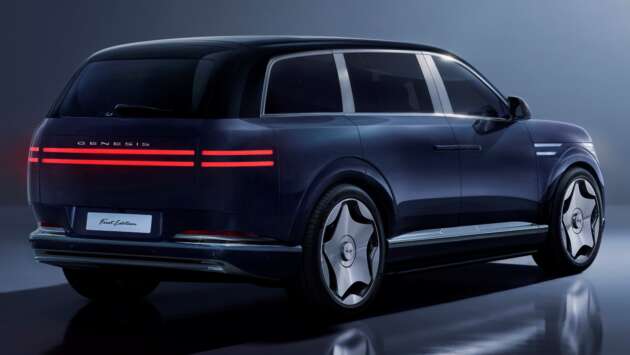
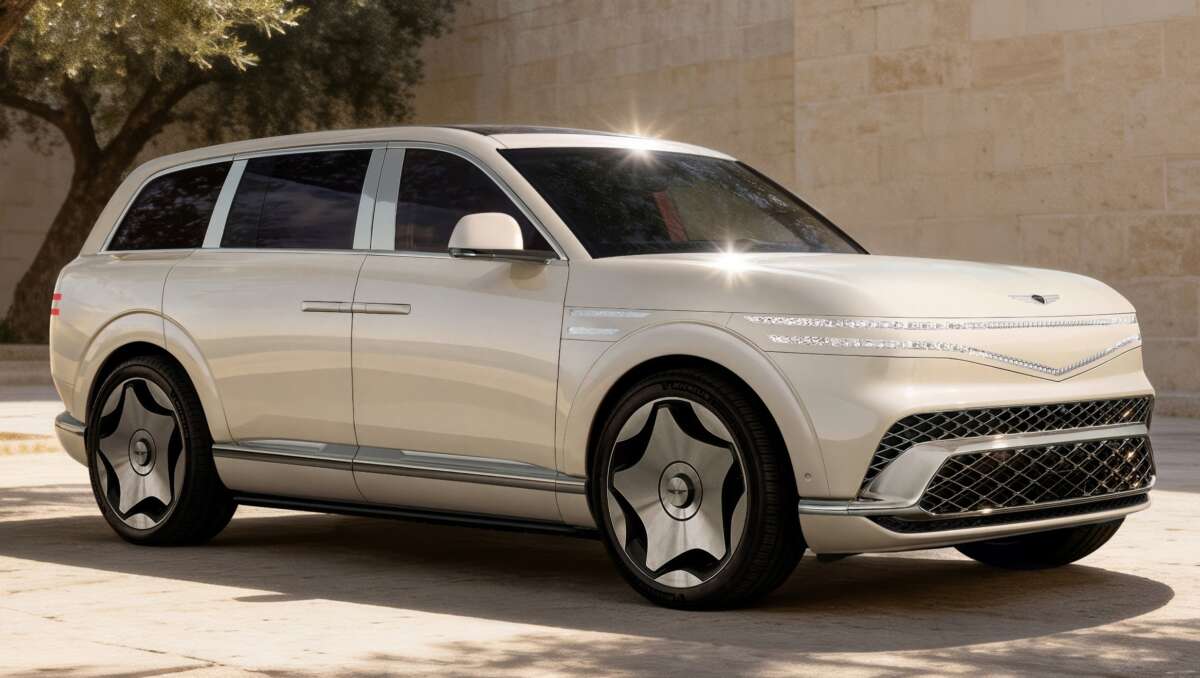
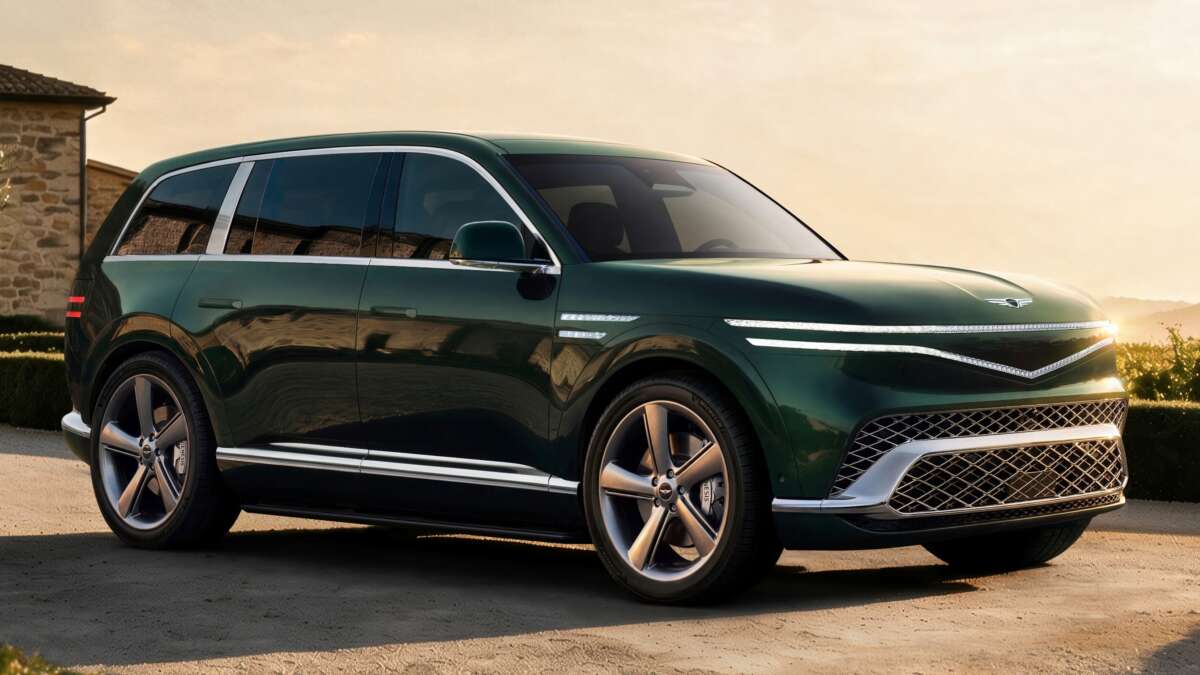
Road presence is a very important factor in this market, the better for intimidating the proletariat into getting out of your way. Genesis has sought to do that not with a massive look-at-me grille, but with a sleek design and restrained detailing – inspired by Korea’s white porcelain moon jars – that almost seems to emphasise the GV90’s sheer size.
At the front, Genesis’ signature Two-Line light graphic diverges towards the centre to form a triangle in lieu of an open grille, forming the first production application of the Wing Face. The company managed to squeeze the jewel-like Micro Lens Array (MLA) headlights into the slim apertures through a laser engraving process. A large bumper aperture with a three-dimensional, dual-layered G-matrix patterned chrome grille provides a hint of menace.
The rear end, meanwhile, is rather round and almost entirely devoid of additional ornamentation, not even a rear spoiler (although a wiper is thankfully included). Instead, you get flush Two-Line taillights, an engraved Genesis script and tasteful chrome fillets. The subtly accented wheel arches house rollers that measure either 22 or a massive 24 inches.
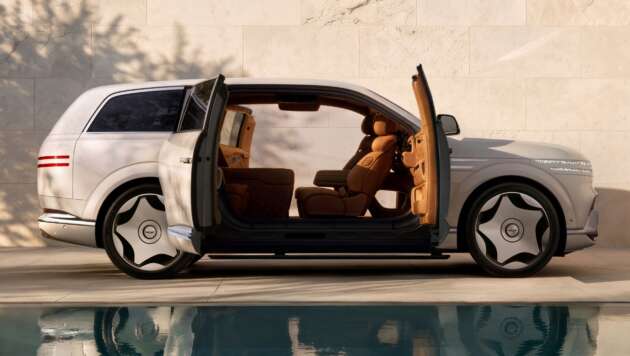
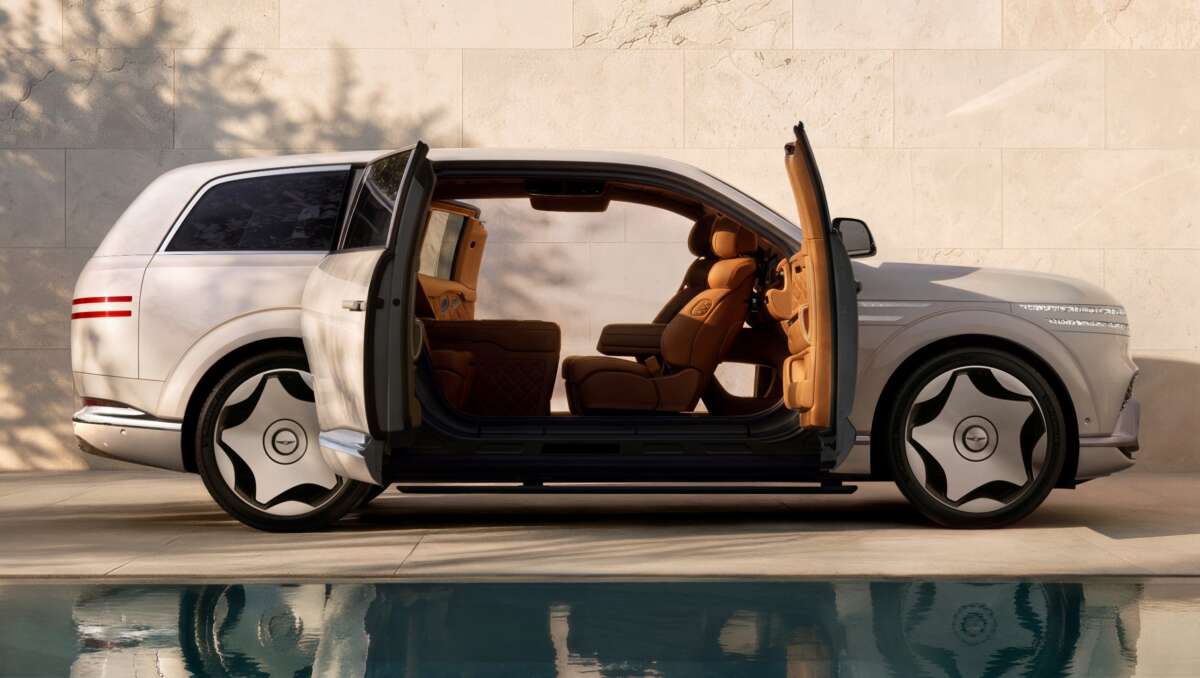
But it’s at the side where the Neolun distances itself from the rest of the herd. Whereas the standard model comes with conventional doors, this car comes with suicide doors (powered, of course) with integrated B-pillars, making these the first to be individually openable front or rear (no, the Zeekr Mix‘s quad sliding doors don’t count).
To afford the GV90 such airy, unimpeded access to the cabin, Genesis has had to reengineer the extruded and cast aluminium structure to more rigidly lock the doors to the body, as well as incorporating dual high-strength steel beams and a robust roll cage. The latter utilises high-strength steel tubes and structural foam in a frame 1.5 times thicker than a conventional car, all to improve crash safety.
Further aiding entry and egress are dual-motion hinges that push the rear doors slightly rearward before opening them wider. You’ll be able to spot a Neolun through the anodised aluminium B-pillars in place of the usual black flush glazing.

Make no mistake, the GV90 is properly vast. Measuring 5,285 mm long, 2,030 mm wide and 1,815 mm tall, it’s longer than the GLS, the X7 and even the Bentayga, although those cars are fairly long (pun not intended) in the tooth. It is, however, shorter than the Q9 and the Cullinan, although its 3,245 mm wheelbase knocks all but the Roller into a cocked hat.
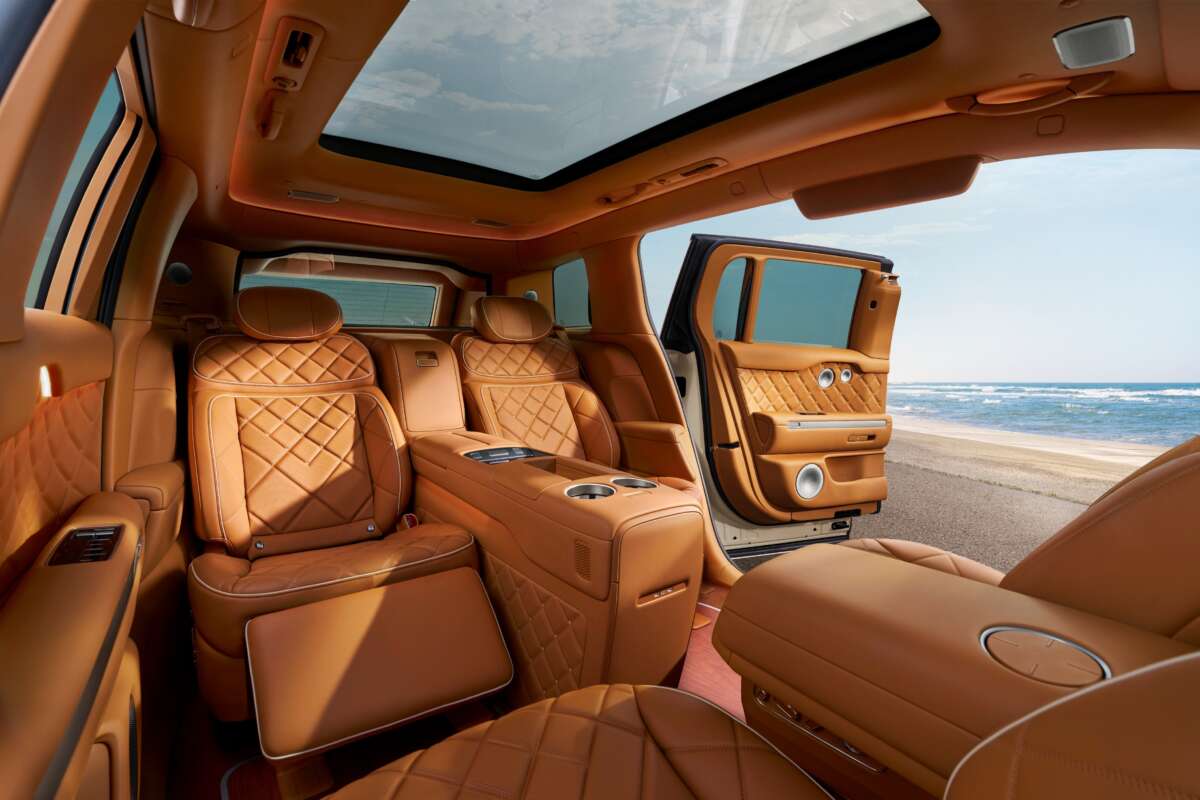
The generous dimensions provide ample space for up to seven people, and here is where the Neolun completes its transformation – when parked, its front seats can be rotated 180 degrees to face the rear seats (yes, just like that Mix), creating a lounge of sorts.
As you can imagine, the interior is exceedingly plush, with a layered dashboard that allows for interesting colour combinations and hides indirect ambient lighting, while the almost flat door panels seem to provide extra space for occupants. The placement of the seats, centre console and the almost TV-like infotainment touchscreen are said to be inspired by luxury furniture, and buyers can specify wood, stone or even cashmere decor.

Speaking of the touchscreen, it’s a massive 23.6-inch OLED panel that runs on the Hyundai group’s Android Automotive-based Pleos Connect operating system – and that’s when you’re driving. Park up, press a button and it extends by 90 mm to a 24.6-inch display for you to watch all the content you want to your heart’s, well, content. Taking the place of the usual instrument display is a 25-inch head-up display.
The technology on board also includes generative AI-assisted Gleo AI voice control, as well as a 25-speaker Bang & Olufsen Premier 3D surround sound system with tweeters that rise from the dashboard. Unfortunately, it appears that you are paying more for fewer physical controls, with those for the air con and even the vents themselves moving to the screen. However, the centre knob – with a display that doubles as an analogue clock – does allow you to adjust media, temperature and airflow settings.
Elsewhere, every seat features 15-point massage and a pulse vibration feature, and for the ultimate in luxury, the GV90 Neolun is also offered in four-seater Executive Suite trim. This adds semi-aniline leather seats and a tower rear centre console with a built-in fridge and fold-out tables, while a rear partition blocks off noise and intrusion from the boot. There’s also an electrochromic panoramic glass roof that can be frosted in sections.

The GV90 is the first Hyundai group model not to come with a start button, and once the doors close, the (rather odd-looking) steering column-mounted gear selector moves from the 12 o’ clock to the 2 o’ clock position, with the crystal sphere on the centre console also rotating to reveal an integrated controller. The car starts by pressing the brake pedal, just like on a Tesla.
Built not on Hyundai’s e-GMP architecture but on a bespoke Electric Mobility Prime (eMP) platform, the GV90 utilises a relatively modest dual-motor all-wheel-drive powertrain, albeit with the group’s most powerful motor. The one at the front makes 326 PS (240 kW) and 350 Nm of torque, while the rear churns out 340 PS (250 kW) and 450 Nm, resulting in a sum total of 666 PS (490 kW) and 800 Nm.
The GV90 also uses the group’s biggest battery yet, at 123.5 kWh; even so, its sheer size and weight means it only achieves around 500 km of range during internal R&D testing. It also continues to utilise an 800-volt electrical architecture; frustratingly, Hyundai continues to not quote a specific DC fast charging capacity, only saying that at a 350 kW charger, the car can be topped up from 10 to 80% in 22 minutes.

Helping to give the GV90 respectable road manners are electronic limited-slip differentials at the front and rear, matched with multi-chamber air suspension, adaptive dampers and up to five degrees of rear-wheel steering. Large-capacity brakes with four-piston front callipers haul the car down to a stop, while five-millimetre-thick acoustic glass all around, high-expansion soundproofing foam, reinforced insulation and modified sealing cut out external noise.
Safety-wise, the GV90 comes with no less than 12 (!) airbags, including the world’s first roof airbag that deploys in a rollover to prevent occupants from being ejected out the glass roof. There’s also an airbag built into the seat cushions to prevent submarining, while an in-cabin monitoring system recognises each passenger’s seating posture and adjusts the airbag and seat belt deployment to suit. It will even alert you if you’re not seated properly.
So there you have it, the Genesis GV90, a car aimed at providing the ultimate in Korean excess. What do think – has the brand finally made its mark in the luxury space, and does this thing put it on a par with its Anglo-Saxon counterparts? Let us know in the comments.








Zeekr 9X full size rivals 1400ps 1400Nm say welcome to the Rolls Royce entry game.
korean EV tech is inferior , giant battery but can only go up to 500km range with slow DC charging . same as their junk samsung s26 charging only 45watt while ccp phones already 110w.
Beauty is really in the eyes of the beholder.