
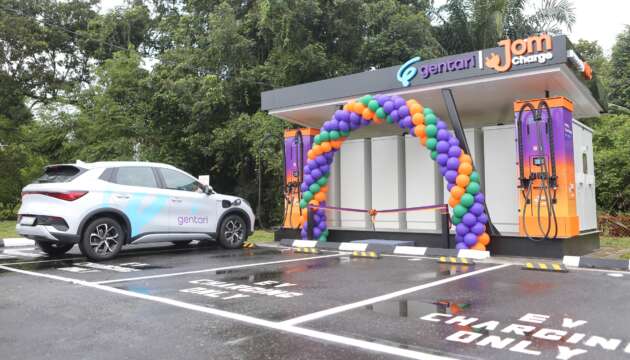
By 2028, a total of 350 electric vehicle (EV) charging points will be installed across the North-South Expressway (NSE) the East Coast Expressway 2 (ECE2), Berita Harian reports.
According to PLUS Malaysia managing director Datuk Nik Airina Nik Jaffar, the planned EV charging points are part of efforts to strengthen the low-carbon mobility ecosystem and a continuation of the company’s Phase I Development Plan.
“Through the initial phase, 118 DC fast charging points are already operating in strategic locations, including rest and treatment (R&R) areas, roadside stops and selected petrol stations. The initiatives under the Phase II Development Plan are the company’s main instruments in supporting the Low Carbon Mobility Development Plan (2021-2030) and the PLUS 2.0 Green Roadmap,” she said.
To meet the surge in EV users during the festive season and long holidays, Nik Airina said PLUS is intensifying the development of a large-scale charging hub at R&R Seremban (southbound). “The project, a joint venture with Yinson Green Tech (YGT), will feature approximately 20 DC charging points, making it the first integrated EV charging hub on a Malaysian highway and is expected to be fully completed in 2027,” she explained.

“To accommodate demand this year, PLUS plans to add between 20 and 30 charging points in strategic areas with high traffic flow, especially the north-south corridor which has been identified as potentially experiencing capacity constraints during peak hours,” she added.
PLUS will also introduce a pilot project known as ‘Charge and Chill’ as part of a contingency plan to reduce congestion at major R&Rs. This combines EV charging infrastructure with F&B outlet facilities to provide users with a more comfortable rest stop experience.
“To avoid long waiting times, EV users are advised to plan their journeys in advance by checking the status of charger availability in real time via the Plus application. Users are also encouraged to utilise apps from relevant charge point operators such as JomCharge, Gentari Go and ChargEV to monitor charging sessions more easily and help reduce congestion at certain locations,” said Nik Airina.
She also pointed out that all EV charging sites along PLUS and ECE2 highways include DC charging points with power outputs ranging from 47 to 200 kW. “This system uses a universal CCS2 connector that is compatible with the majority of EV models on the market, allowing vehicles to charge the battery up to 80% in a rapid period of around 15 to 30 minutes,” she said.


for what subsidize East coast SG4, they are going to vote for PAS ad PN
this is called hak bumiputera, learn to respek ok?? jangan biadap!
why is everything about religion to your type?