
The formats for juicing up vehicle powertrains are straightforward – refueling for internal combustion engines and hybrids, recharging for electric vehicles, and for plug-in hybrid (PHEV), a combination of both. The last is great way to straddle both worlds, ideal for those wanting to sample the virtues of electrification but with a traditional fallback plan.
Of course, to reap the full benefits of that configuration, you’ll have to be diligent about it for the best results, efficiency-wise. This means charging and using it as much as possible as an EV, with the combustion part the back-up, supporting those moments when you don’t have easy access to charging, or for long-range travel without needing to work out a running plan for charging.
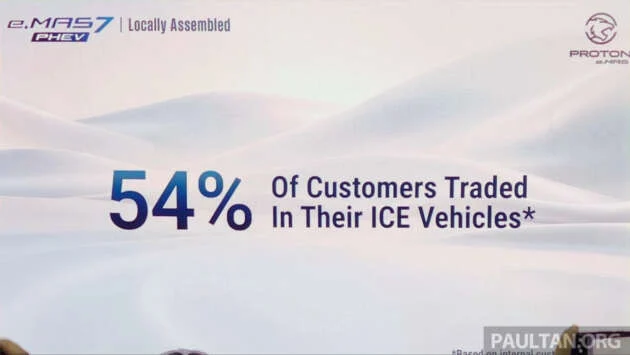
If you’ve been wondering how PHEV owners approach this repeating aspect, Proton has some interesting data on it, revealing its findings in a presentation at today’s line-off ceremony for the locally-assembled (CKD) Proton eMas 7 PHEV. Since its introduction in February, 4,543 units of the SUV have been delivered at this point, with 54% of buyers trading in their ICE cars for it.
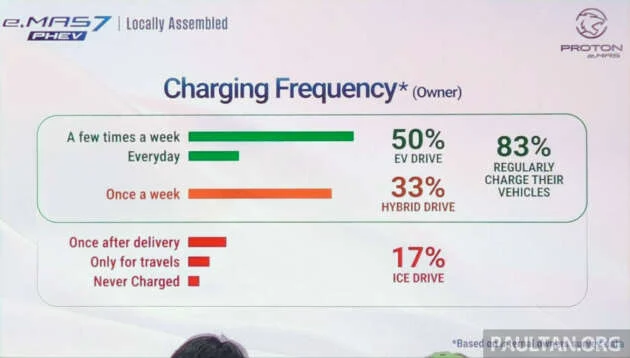
As to how they go about recharging it, the company says that data has revealed that 83% of owners regularly charge their vehicles, with 50% of them approaching it as an EV and 33% as a hybrid, most of them charging the car a few times a week (there was no specifics as to how many times exactly), with some plugging it in on a daily basis and, on the other end of the scale, topping the battery up once a week.
Intriguingly, 17% of buyers, or 772 people, as based on the overall deliveries so far, ran the SUV virtually as an internal combustion engine offering, charging their car once after taking delivery of it, with some never even having used a charger at all after purchase. There were also those who did so only for travels, which sounds counterpoint to the whole idea of a PHEV in the first place.
Taking away the too-much-hassle-to-plug in crowd, it could be that most who never plugged in the car at all may have thought they were buying a hybrid, which utilises the engine as a generator to juice up the battery for electric propulsion for the most part. While the eMas 7 PHEV can recharge the battery using engine power, it is not a default setting and has to be manually selected.
In its full glory, the eMas 7 PHEV has a neat 262 PS and 262 Nm, with the electric motor part of the combination contributing 218 PS/262 Nm to the equation. Without the electrified aspect, it’s left to the BHE15-DFN 1.5-litre naturally-aspirated Atkinson-cycle four-pot engine and its 99 PS and 125 Nm to lug the SUV around, surely not the most efficient way to do so – as we’ve said before, there are better ICE SUVs out there in terms of performance compared to a 1.5 litre NA eMas 7 PHEV without electric assistance.
The point is, and always has been, that in an urban environment, a PHEV should be approached primarily as an electrified offering, the battery and electric motor providing green, cost-effective travel across daily commutes, plugged in at the end of the day or at a destination via the AC route, with the ICE part of the combination filling in the gaps such as on longer travels or when there is no ready access to AC chargers.


In daily use, a single tank of fuel could go for months, if the car is used as advertised on the tin. In this case, a pure electric range of 83 km, or 943 km combined, with the Prime and Premium equipped with an 18.4 kWh lithium iron phosphate (LFP) battery from CATL, or 146 km of all-electric range and a combined 996 km with the top Premium Plus variant, which has a 29.8 kWh Geely Aegis short blade LFP pack.
Should you choose to use the eMas 7 PHEV purely as a EV, which means fully charging it up (no issue with LFP) and repeating the cycle every 100 or so km, the slow usage of fuel won’t be an issue, as the car’s pressurised fuel tank means the evaporation of fuel and natural process of fuel degradation is considerably slowed down.
Of course, the car can be driven without ever being plugged in. As explained in an earlier post, the battery has a self-preservation mechanism and should well last the distance, in this case right through its eight-year or 160,000 km warranty for it and other relevant EV equipment, but why would you buy a PHEV without utilising the battery at all throughout the car’s lifetime of service with you? It’ll be interesting to see what the next set of usage data for the car reveals, moving forward, as more buyers come on board.




 Proton eMas 7 PHEV
from RM109,800
Proton eMas 7 PHEV
from RM109,800  Proton S70
from RM59,800
Proton S70
from RM59,800  Proton X90
from RM106,800
Proton X90
from RM106,800  Proton X70
from RM106,800
Proton X70
from RM106,800  Proton Saga
from RM38,990
Proton Saga
from RM38,990  Proton eMas 5
from RM59,800
Proton eMas 5
from RM59,800  Proton X50
from RM89,800
Proton X50
from RM89,800  Proton eMas 7
from RM103,800
Proton eMas 7
from RM103,800 

Those drives like ICe car never charged battery for 1 month, 3 month, 6 month or more? Beware of deep discharge affecting the battery soc, why drives phev but lazy to charge the battery at least once a month? Since it will be heavier and less fuel-efficient than it could be, as you’re carrying a large battery without using its full potential.
ya if those idiots treat it like ICE car, then why buy hybrid in the first place?? wheres the brain?
in my T20 landed house neighbourhood, few of my neibghbours have PHEV volvo, bmw , merc. yet i never seen any of them charge their car at home. they use the engine only all the time. so are you calling T20 brainless?
Guailou phev are fake. Can jalan 30km per charge. No point plugin.
The tiny battery means it’s cycled heavily, making the design pointless
Not sure about BMW but Volvo PHEV like the XC60 will recharge the battery via the engine once the battery is depleted. So technically one can drive the car without ever charging the battery via external charger.
pekat betul kesohaian pakai ICE mode only, engine carry deadweight battery mass, lg byk burn petrol burn Budi, betul2 sohai
The Proton e.MAS 7 PHEV can also self-charge by maintaining a forced battery reserve of 20%, ensuring that its full 0-100 km/h acceleration performance of around 8 seconds remains available when needed. Its fuel efficiency also remains impressive even when the vehicle is not regularly plugged in.
Goodbye to traditional PHEVs that often struggled to deliver their intended real-world benefits. This is the new generation. Better aligned with the Paris Agreement and global sustainability efforts.
most owners dont even know they buy a hybrid. probably sweet talk by the type c salesman, u dont like ev right. get this la. got engine, no need charge one. 2 years later, module all got issue the salesman already resigned working for chery already
Other people’s car. Why we bother how they use them, esp. when it did not involve driving behaviour? Most likely these people just want cheap hybrid, but since eMas7 gives the most space at that price point (+ local brand), they believe this car gives them most money woof. Plus, don’t all the pure EV people despise PHEV charging?
I still maintain PHEV is the better solution than EV since you can use EV for urban areas and fire up the ICE for long distance journey. But as the article has stated, you need to use both powertrain to get the most out of it.