

Of all the big-name Chinese new energy vehicle players, Li Auto has been the most stubbornly home-focused. While BYD conquered our region on the back of an early commitment to right-hand drive, the Beijing-based EREV pioneer has never built a single RHD car in its 10-plus years of existence. That is about to change.
Li Auto president Ma Donghui confirmed during the company’s first-quarter earnings call that a right-hand-drive version of the Li Mega – the brand’s flagship pure electric MPV – will launch in Hong Kong and Singapore by the end of 2026. It will be the first RHD product in the company’s history, and crucially, Li Auto has also said that all new models from 2026 onwards are being developed with simultaneous adaptation to overseas regulations, meaning future products should be RHD-capable from day one rather than as an afterthought.
In late June, Li Auto opened its first retail presence in Greater China outside the mainland, in Macau, through third-party dealer Guangdong Hongyue Automotive Sales Group. The Macau line-up consists of the i6 and i8 electric SUVs – still in left-hand drive, as the territory permits LHD registrations for cross-border travel into Guangdong – but with telling localisation work. The cars get Fuyao dual-layer laminated non-privacy glass to meet local light transmittance rules, dual SIM slots for seamless cross-border connectivity, and an overseas infotainment build with Apple CarPlay and Spotify – things you won’t find on domestic-market Li Autos.
Notably absent from Macau are the L-series extended-range models that built the brand. The territory’s progressive vehicle tax, which runs up to 70% based on engine displacement, classifies the L8 and L9 EREVs as hybrids because of their 1.5 litre petrol generators, excluding them from zero-emission exemptions. Sound familiar? It’s the same treatment EREVs would get in Malaysia, where EV tax incentives apply strictly to full battery-electric vehicles.

So, is Southeast Asia in the plan? Officially, yes. The company has announced entries into Cambodia, Laos and Myanmar this year through local distributors, and a distributor-led retail presence has been operating in the Philippines since last year. Those are all left-hand-drive markets served by mainland-spec cars, however – Singapore will be Li Auto’s first RHD beachhead in ASEAN.
The wider globalisation push has been rapid for a company that only opened its first overseas store, in Uzbekistan, in October 2025. Since then it has entered Kazakhstan, Egypt and Azerbaijan, signed distributors in the UAE, Saudi Arabia and Kuwait, begun its first overseas assembly operation in Kazakhstan with local partner Allur, and launched a heat-optimised international version of the new L9 for the Middle East.
There’s urgency behind it, as Li Auto posted a record RMB2.3 billion (RM1.36 billion) net loss in the first quarter of 2026 against a RMB647 million profit a year earlier, with May retail sales in China at 33,350 units and trending down amid brutal domestic competition. To grow, it needs to go beyond the domestic market.
Which brings us to Malaysia. To be clear, there has been no official word on a Malaysian entry – Singapore and Hong Kong are the only confirmed RHD markets so far. But the logic is hard to ignore. Once RHD engineering, homologation experience and regional parts supply exist for Singapore, extending across the Causeway is a far smaller step, and Li Auto’s preference for appointing established third-party distributors rather than building direct-sales operations means it could move quickly with the right local partner.

The Mega RHD is the obvious spearhead, because it will already exist. Priced from RMB559,800 (around RM330,000) in China, the streamlined 5.35-metre MPV packs a 102.7 kWh CATL Qilin battery with 5C charging – Li Auto claims 500 km of range added in about 11 minutes, though even Malaysia’s fastest public DC chargers wouldn’t max out that capability – plus dual motors, air suspension and a seven-seat lounge of a cabin. It would land squarely in a premium electric MPV segment that Malaysia has already validated, going up against the Zeekr 009, Xpeng X9 and Denza D9, with the Toyota Alphard and Vellfire as the incumbent status symbols.
The i-series electric SUVs would logically follow. The i8, from RMB339,800 (about RM200,000) in China, is a six-seat large SUV that would slot in against the likes of the AITO M9 and the incoming Zeekr 9X, while the upcoming i9 flagship – recently revealed in Chinese regulatory filings at 5,225 mm long with a 3,168 mm wheelbase and 400 kW dual motors – would top the range. The trickier one is the i6, which at RMB249,800 (roughly RM147,000) in China would be the natural volume seller here.
Trouble is, Malaysia’s post-incentive rules now require CBU EVs to have a minimum CIF value of RM200,000 (alongside a minimum 180 kW output) from July 2026, effectively barring the i6 as a fully-imported model. Unless Li Auto commits to local assembly – which would unlock excise and sales tax exemptions until end-2027, as BYD and others are pursuing – expect any Malaysian debut to start from the top with the Mega, i8 and i9 as CBU imports, now taxed at 5% import duty (for China-built vehicles under ACFTA) plus 10% excise and 10% SST.
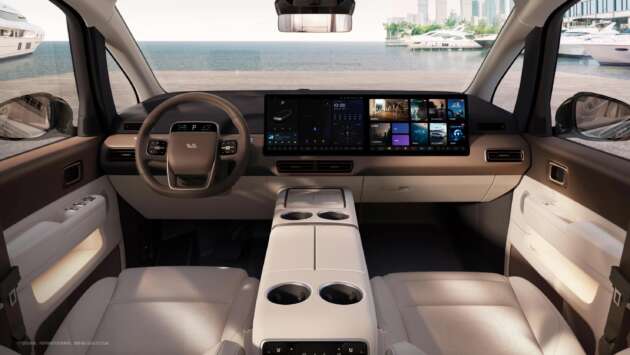
As for the L-series EREVs that made Li Auto famous, don’t hold your breath. With no EV incentives applicable and full conventional-car duties in play, they’d be priced out of contention here for exactly the same reason Li Auto left them out of Macau.
Realistically, if the Hong Kong and Singapore launches proceed on schedule in Q4, the earliest plausible window for a Malaysian entry would be some time in 2027 – assuming Li Auto decides we’re worth the trip, and there’s a distributor willing to take on yet another Chinese brand in an increasingly crowded market.
Would you have a Li Mega over an Alphard, 009 or X9? Sound off in the comments.


i just find the design really ugly and i wonder what the turning radius would be like. Then the dashboard design is so boring – the same as everyone else. The same for the interior – same boring stuff as everyone else. If you are coming into the market for the first time, I would think you would do something spectacularly different: maybe have wooden floorboards that Paul Tan talked about recently for a different model. Otherwise the rakish angle outside makes me think of Tesla Cybertruck but in an even uglier way.