

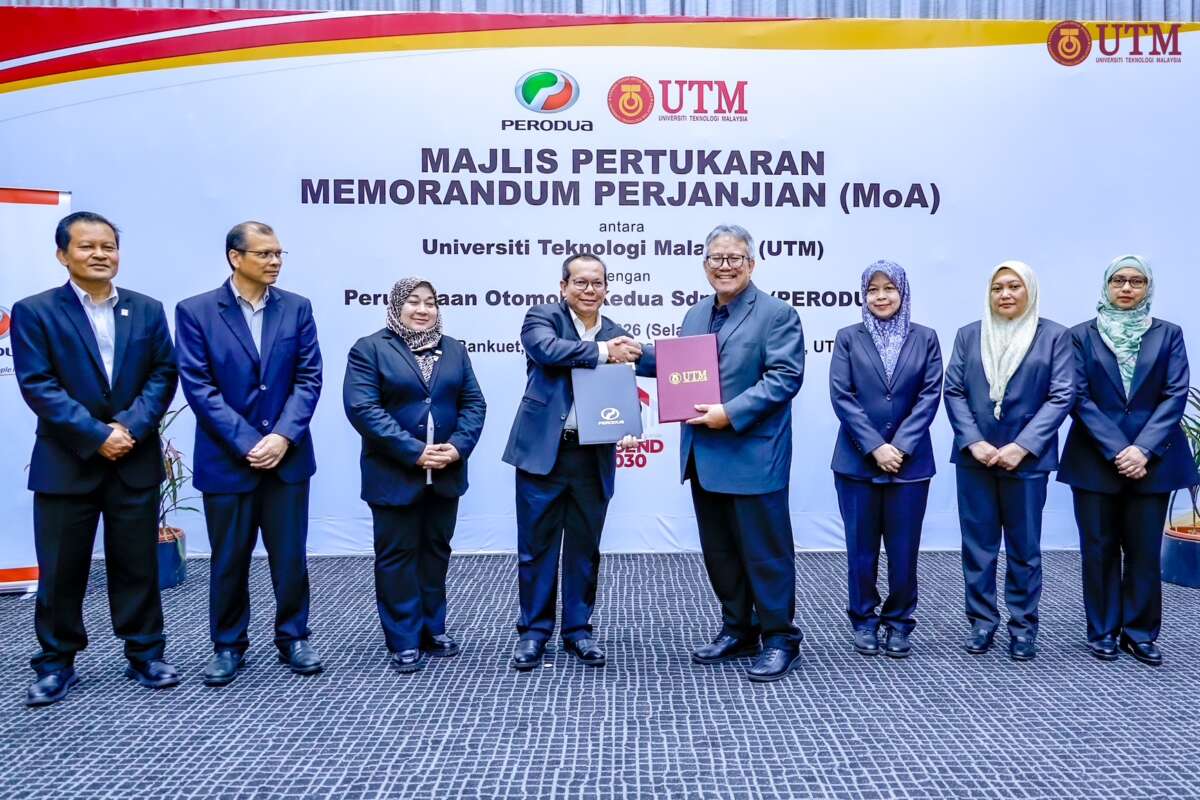
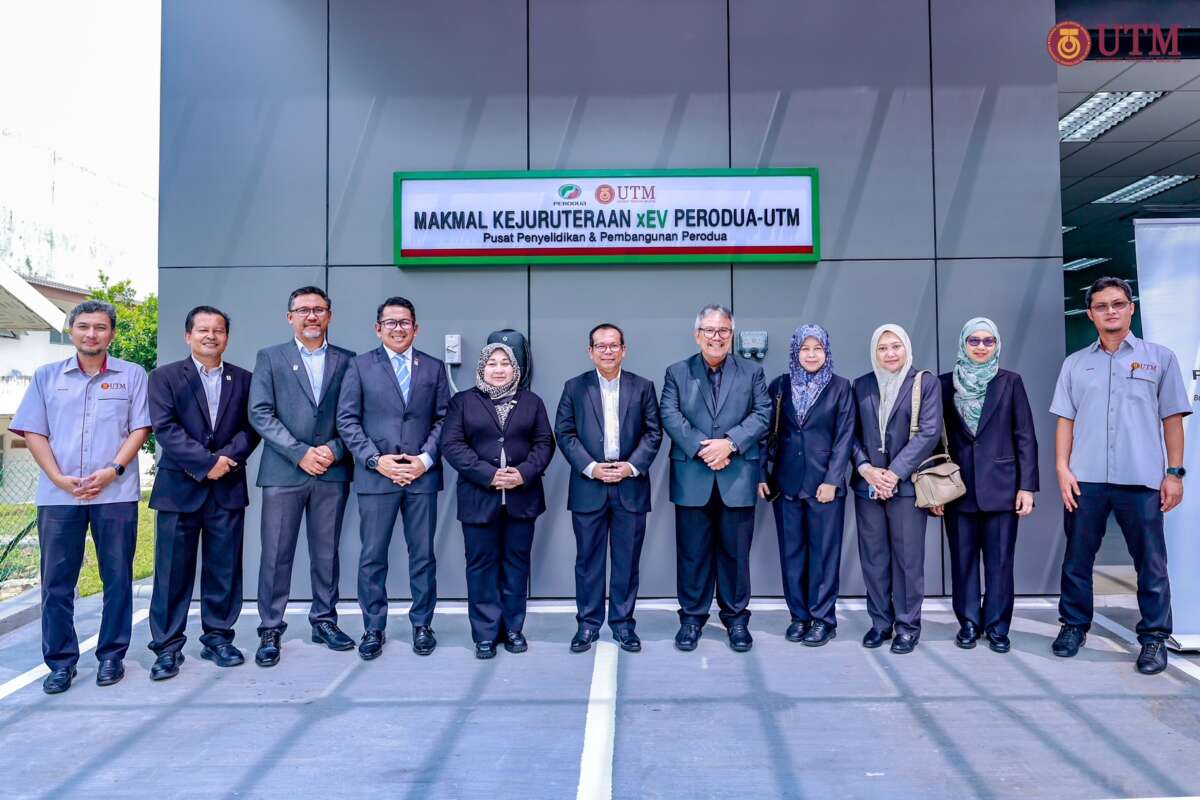
Perodua and Universiti Teknologi Malaysia (UTM) yesterday put out a joint-release to announce the signing of a memorandum of agreement for an xEV engineering programme. Essentially, both parties will collaborate on next-gen EV technology, involving human capital development and research.
Not earth-shattering news, especially when it’s a continuation of the memorandum of understanding signed in January 2025 for the same, and Perodua’s no stranger to bridging industry and academia. What made us sit up was one of the photos accompanying the release, which you can see above.
Between the two QV-Es Perodua donated to UTM for study purposes, sits a second-gen Myvi facelift with an EV-style number plate that says ‘Nexus EV’ (not to be confused with Nexis, which is what the Traz would otherwise have been called). Nexus is also the name of UTM’s research magazine, as well as a place in Bangsar South, but I digress.

Of course, this is not an official Perodua product, but what’s interesting is the technology. The Nexus EV is the work of UTM and NanoMalaysia (a company limited by guarantee under the science, technology and innovation ministry, or MOSTI). It’s a Myvi converted into an EV, but it uses something called a Hybrid Electric Storage System (HESS).
No, that doesn’t make it a hybrid. The word here refers to the fact that there are two energy storages – batteries and supercapacitors (like a Lamborghini Sian, man). UTM explains in an article that pairing the two “can improve power quality during high transient demands, such as sudden acceleration or repeated stop-start traffic, while protecting battery life by smoothing current spikes.”
“Batteries excel at storing energy for range, and supercapacitors excel at delivering and absorbing high power quickly. In the converted Myvi, the supercapacitor reduces peak current draw from the battery during accelerations and captures high-power regenerative braking energy with lower losses. Supercapacitors help extend battery cycle life by reducing strain on the batteries,” says the article.


The team developed a custom energy management system with sophisticated control algorithms to switch seamlessly between the two energy sources – the batteries and supercapacitors.
The Nexus EV has a 129 PS/235 Nm electric motor, a 10-second 0-100 km/h time (current Myvi 1.5: 102 PS/136 Nm, 10.2 seconds), a 26-kWh lithium-ion battery, a 250-km “practical driving range” and an onboard charger that can top up the battery to 80% in about an hour.
Packaging the battery modules within the small car required a custom battery enclosure design with a thermal management system. UTM says the addition of battery packs (around 200 kg) would cause a weight imbalance that would in turn necessitate reinforced mounts and suspension upgrades. Indeed, you can see that the boot is chock-full of gubbins, so it’s not exactly a practical solution…

… yet. “The next steps include improvements on battery packaging, developing more advanced battery thermal management systems, an enhanced HESS energy management system and exploring fast-charging protocols that leverage the supercapacitor module to reduce peak battery stress,” says the article.
It would be easy to dismiss this as nothing more than a weekend project, but Perodua has said many times that it thinks batteries are the biggest barrier to EV adoption in Malaysia. The company’s concerns surrounding cost, battery degradation and resale value are big reasons for the QV-E’s much-maligned battery leasing scheme.
Likewise, the UTM article cites “high costs” and “reliance on foreign technology” as things that hinder widespread EV adoption, and Perodua president and CEO Datuk Seri Zainal Abidin Ahmad has said before in an interview that the QV-E is facing issues with some of its Chinese suppliers – and we know the QV-E’s battery comes from China. As HESS and supercapacitor technologies continue to develop, do you think they can help P2 reduce reliance on expensive batteries and foreign technology?


 Perodua Traz
from RM76,100
Perodua Traz
from RM76,100  Perodua QV-E
from RM69,999
Perodua QV-E
from RM69,999  Perodua Axia
from RM33,900
Perodua Axia
from RM33,900  Perodua Alza
from RM62,500
Perodua Alza
from RM62,500  Perodua Myvi
from RM46,500
Perodua Myvi
from RM46,500  Perodua Ativa
from RM62,500
Perodua Ativa
from RM62,500  Perodua Bezza
from RM34,580
Perodua Bezza
from RM34,580  Perodua Aruz
from RM68,900
Perodua Aruz
from RM68,900 

Bla bla bla…… no one paying attention to them.
For academic maybe it is okay, but realistically, it’s quite unlikely to match what Chinese players are already achieving. They benefit from strong government support in R&D and EV Sales, along with established giants like BYD and CATL that dominate the EV battery market with massive scale and share.
As for the QV-E, it’s not welcoming, because the design is poor, the interior feels low quality, and the rear seats are so cramped they’re only suitable for kids. With all these drawbacks, the pricing feels ridiculous compared to their competitors, and the battery rental model (and its marvelous tnc) just ends up being the final dealbreaker.
If that’s how you think then same can be said for emas5 because i can barely see that ugly sin on the road
dont know where you are living at, but in klang valley, a lot of eMas5 zipping around town, and also already few units seen in my workplace carpark
I think perodua got inspiration from Toyota CHR, both have similar design and crampy rear seat
Yawn worthy, nothing to see here waste of your 5mins to read this. The world is moving to Solid state batteries with higher Wh/Kg + faster charge rates and here we have solutions no one asked for.
15 years ago it was Proton making news for experimental alternative propulsion e.g. Saga EV and Exora REV
Does Perodua really think people would take their allegation that their Chinese vendors aren’t meeting their quality standards? Sit inside a Leapmotor vehicle, or a Zeekr. Or even a recently-available Jetour T2.
Pray tell, which of their upholstery, knobs, buttons, etc. feel low-quality? In fact, you won’t find a single piece of trim in these vehicles to be as flimsy and low-quality as what you see in the QV-E.
Perodua is being dishonest and is blaming Chinese vendors for their own poor material quality selection and poor component design. They can boast about Japanese automotive technology roots all they want, but it’s clear that Perodua failed in terms of technology transfer. Let to their own devices, they come up with underwhelming low-quality designs and products.
Reminiscing the “mystical purple” exterior shade
I always remember this as one of the cause we cannot have cheap EV here.
This is just throwing money into the sea and in the same time wasting precious time of the engineering students doing something that have no application in the real world.
Capacitors used to be a possibility, back when the battery tech is ancient, runs at low voltage and cannot absorbed/output big ampere (during regen braking or pedal to the floor). Now days, latest EV battery running at 900v and able to take in 1000kW charging, there is no need for capacitors. Also, unless using a really big and heavy and good quality capacitors, these capacitors probably blew up way before EV battery having an issue.
I can understand the passion, but I cannot understand why they are not fixing the flaw on Q-EV first and jump straight to next project and most likely fail again.
Because it’s Perodua, it’s in their blood. Doing half-ass job trying to “promote” hybrid then despite failing, what? Jump straight to QV-E with the stupid BaaS model? Can clearly see how their brain works by now…
“Perodua has said many times that it thinks batteries are the biggest barrier to EV adoption in Malaysia”
Babe, the price and charging facilities are, Emas 5 is selling well, without the over advertisement style of social media post of the super rich buying QVE because the have a stake in Perodua, QVE or just wanted something special.
The problem is technology battery sekarang semakin berkembang, dan daya ketahanan lebih lama daripada dulu, menyebabkan pertambahan kapasitor tidak perlu. Kapasitor energy density jauh lebih rendah berbanding dengan energy density battery sekarang.
Batteries store roughly 150–250 Wh/kg (and improving). Supercapacitors manage only about 5–10 Wh/kg — an order of magnitude less. To match a 75 kWh EV battery pack, you’d need a supercapacitor system weighing several tonnes and taking up most of the car.
Lagi satu factor perlu diambil perhatian ialah a supercapacitor’s voltage drops continuously as it discharges (it’s a linear relationship with stored charge). Batteries maintain a relatively flat voltage curve across most of their discharge cycle. EVs need stable voltage for drivetrain and electronics, so supercapacitors would require complex, heavy, and lossy DC-DC conversion throughout the discharge. Perodua cant even produce their own BMS. All this will require additional cost to build a BMS to manage this.
Bagaimana guna sebagai hybrid seperti yang dicadangkan dalam artikle dimana engineering proposals combine a battery (for energy density/range) with a supercapacitor (for peak power handling). This can extend battery life by offloading high-current events. But it adds cost, weight, and complexity — and battery technology keeps improving anyway. Macam akan hadapi perbagai halangan dari segi cost and practicality
In short supercapacitors are a power device, not an energy device. EVs need both, but range — the consumer’s primary concern — is an energy problem.
Bagaimanapun saya harap UTM dapat mengatasi halang halangan seperti yang saya point up. But this will take time to developed. What perodua need in the EV front now is a compelling product that is affordable now. Not 5 yrs or 10 yrs from now. And i hope Perodua better put in the hard work of bring out a compelling EV product for normal Malaysian not some T20 target. Toyota will never allowed Perodua to sit above its product line… can see in Perodua Traz. Perodua previous formula by rebadge kancil works well. Why not rebadge those small EV back which is a good start, no need compleks system. Rakyat get an affordable car, Perodua get to learn in time on service, after service technical knowledge which slowly build into manufacturing process. I fear now Perodua is like Proton last time venturing into vapour ware burning resources acheive nothing.
jaguh kampong