

Revealed late last year, the facelifted Hyundai Staria has made its way to Thailand, offering a new hybrid powertrain. This is significant because this new Korean-built model replaces the old diesel van that was assembled in Malaysia in Kulim, Kedah.
That switch has predictably brought a sizeable increase in price, because even the base Modern variant retails at 2,099,000 baht (RM257,400), slightly higher than the outgoing 1,999,000 baht (RM245,200) top-spec Premium that remains on sale for now.
The like-for-like replacement Premium, meanwhile, now costs a heady 2,399,000 baht (RM294,200). Both are 11-seater models, with Thailand being the first country to get the facelift in this configuration, per Autolifethailand.
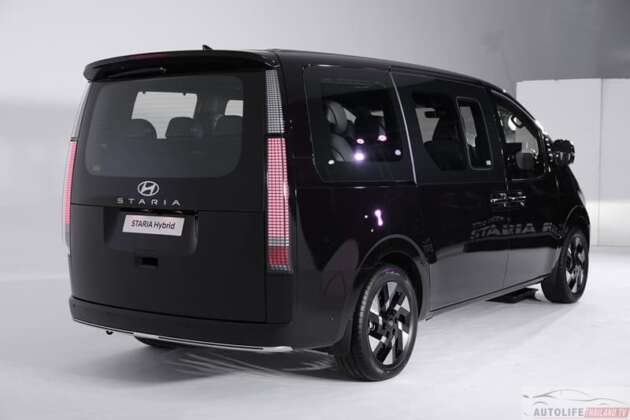
As previously reported, Hyundai ditched the 2.2 litre turbodiesel with this latest refresh, replacing it with the Tucson and Santa Fe Hybrid’s 1.6 litre turbo four-cylinder petrol engine making 180 PS at 5,500 rpm and 265 Nm of torque from 1,500 to 4,500 rpm. This is mated to a 73 PS/304 Nm electric motor and a six-speed auto for a combined 245 PS and 367 Nm – 68 PS up but still 64 Nm down on the old oil burner.
Under the skin, the Staria’s front subframe gets a more rigid connection and more responsive bushings, the latter providing better body control. The Premium’s rear suspension switches to hydro bushings to improve shock absorption and reduce vibration. There’s thicker sound insulation material in the bulkhead, and more sound-absorbing materials have been added to the vehicle’s rear and lower sections.
Beyond that, the visual changes for this futuristic space shuttle are fairly minor. The distinctive upper daytime running light bar is now a single piece that is standard across the range, stamped with the Staria script on the side. The Premium also gets slimmer vertical projector LED headlights that makes space for a big, toothy new grille with chrome “dashes”.


The strip underneath it is also now in chrome and has been subtly reprofiled with a slit on either side, and this is repeated at the rear. The Modern retains the same bumpers and reflector LED headlights as the previous regular Staria. Wheel options include a carryover 17-inch design for the Modern and a new 18-inch turbine-style one for the Premium.
Much larger revisions can be found on the inside. There’s a whole new dashboard that features a more angular design and a more conventional waterfall-style centre console that places the air-con vents directly below the infotainment touchscreen.
Speaking of which, both the instrument and infotainment displays are larger, now measuring 12.3 inches across (up from 10.25 and eight inches respectively). There’s also a new steering wheel with four dots – Morse code for the letter H – taken straight off the Santa Fe.
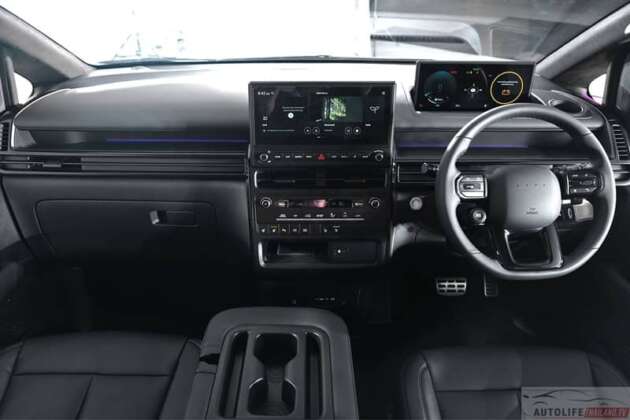
Elsewhere, the Premium gains a steering column-mounted gear selector, ditching the centre console buttons. Last but not least, the Staria has gained support for Hyundai’s Bluelink smartphone-based remote vehicle functionality, with the addition of Internet connectivity also enabling over-the-air updates.
Standard kit is vast and includes Panoramic Pixel LED taillights, keyless entry with remote start, push-button start, a heat-insulating windscreen and front side windows, paddle shifters, power-adjustable front seats, leather upholstery, front and rear auto air con, rear sunshades, six speakers, a 360-degree camera system and a hands-free powered tailgate.
The Premium adds a acoustic front glass, suede trim, a stitched console panel, dual sunroofs, heated and ventilated front seats, aluminium pedals, side sill scuff plates, ambient lighting, a Qi wireless charger and a 12-speaker Bose sound system.


Safety kit is identical on both models and include six airbags, stability control and a full complement of SmartSense driver assists.
The latter include autonomous emergency braking with intersection collision avoidance, adaptive cruise control with stop and go, lane centring assist, blind spot monitoring with collision avoidance, rear cross traffic alert with auto brake, front departure alert, a driver attention monitor, a door opening warning, a rear seat reminder and auto high beam.
The fact that Thailand has had to source its facelifted Staria means that it likely won’t be offered in Malaysia so soon; hopefully we will receive it next year. That should coincide with a switch to a hybrid powertrain, although that’s less crucial for our market now that diesel fuel is back to being subsidised. No word on the new electric model as yet.


 Hyundai Staria
from RM179,888
Hyundai Staria
from RM179,888  Hyundai Stargazer
from RM99,800
Hyundai Stargazer
from RM99,800  Hyundai Ioniq 5 N
from RM443,888
Hyundai Ioniq 5 N
from RM443,888  Hyundai Ioniq 6 N
from RM449,888
Hyundai Ioniq 6 N
from RM449,888  Hyundai Santa Fe
from RM225,000
Hyundai Santa Fe
from RM225,000  Hyundai Tucson
from RM159,800
Hyundai Tucson
from RM159,800 

Andy says he don’t wanna play with you anymore