

First shown to the world in August, the new fifth-generation Hyundai Tucson has been fully revealed ahead of it going on sale in Korea later this year, with other markets to follow in 2027. This time, we get full details of the powertrain lineup to go with the controversially edgy design.
Four carryover options will be offered, including two four-cylinder petrol engines – a 150 PS/192 Nm 2.0 litre naturally-aspirated MPI and a 193 PS/265 Nm 1.6 litre T-GDI turbo; the 2.5 litre NA GDI has been nixed. In Europe, the turbo mill is markedly less powerful, producing 150 PS and 250 Nm even with a 48-volt mild hybrid system.
The base 2.0 litre will still be available with six-speed manual and auto gearboxes, while depending on the market, the 1.6 litre turbo can be had with either the manual, a seven-speed dual-clutch transmission or an eight-speed auto. Both engines are fitted with the world’s first integrated electric water pump to save weight while maintaining performance and reliability.
Next up is the hybrid, which continues to pair the 1.6 litre turbo with an 18 PS P1 starter-generator, a 65 PS P2 traction motor and a six-speed auto for total outputs of up to 245 PS and 380 Nm of torque. It’s available with front- or all-wheel-drive, with the former getting from zero to 100 km/h in 8.3 seconds and delivering fuel consumption of 17.4 km per litre.
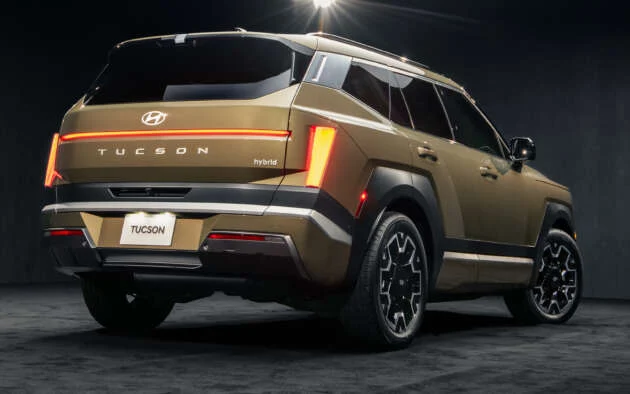
The biggest change is to the plug-in hybrid, which has a much punchier 107 PS P2 motor, boosting outputs by some 27 PS and 30 Nm to 292 PS and 380 Nm. This is only available with AWD and sprints to 100 km/h in 7.9 seconds, and with a 17.1 kWh battery, the PHEV is targeted to offer a pure EV range of 81 km – around 20 km more than before. Charging capacity using an AC wallbox has also been increased to 7.2 kW.
Hyundai has confirmed that the Tucson will retain its short and long wheelbase variants (Malaysia got the LWB version last time out). Both are larger than before, with the European SWB model measuring 4,560 mm long, 1,900 mm wide and 1,670 mm tall with a 2,720 mm wheelbase and the LWB being 4,700 mm long, 1,905 mm wide and 1,685 mm tall with a 2,785 mm wheelbase. The front overhang is 20 mm longer for better pedestrian crash protection.
Under the skin, the Tucson benefits from an increased use of hot-stamped steel for better body rigidity and impact resistance, while reinforced B-pillars and multi-point collision energy management absorb and distribute impacts to maintain long-term structural integrity, all in the name of quality, safety and reliability. Refinement has also been improved through enhanced sound insulation and sealing and aerodynamic tweaks.


The past month has given us time to digest the polarising new look, but it’s still not exactly a wallflower. The Tucson sticks to the futuristic theme, but instead of the previous blend of curves and straight edges, there’s now a much more austere aesthetic, bringing to mind the Elantra. This is part of the Art of Steel design language that we first saw on the Ioniq 3.
It’s altogether less sporty and more architectural, with voluminous flared fenders that emphasise the car’s muscular stance and enhance the interplay between light and shadow. Hyundai says that the clean surfacing and sharp character lines combine to create the tension that is characteristic of steel, whatever that means. Silver window trim and D-pillars provide added contrast against the wraparound windscreen design.
The front and rear ends are dominated by the full-width H lighting signature that is again reminiscent of the Elantra. The horizontal light bar at the front is recessed and provides soft indirect lighting, while the taillights get a prism structure and reveal an intricate pattern when lit.


The main headlights are hidden within the bumper, as per the outgoing model, and they can now be optioned with micro pixel light (MPL) technology with 25,600 individual LEDs, enabling precise beam control and rain guide lights. Wheel options range from 17 to 20 inches.
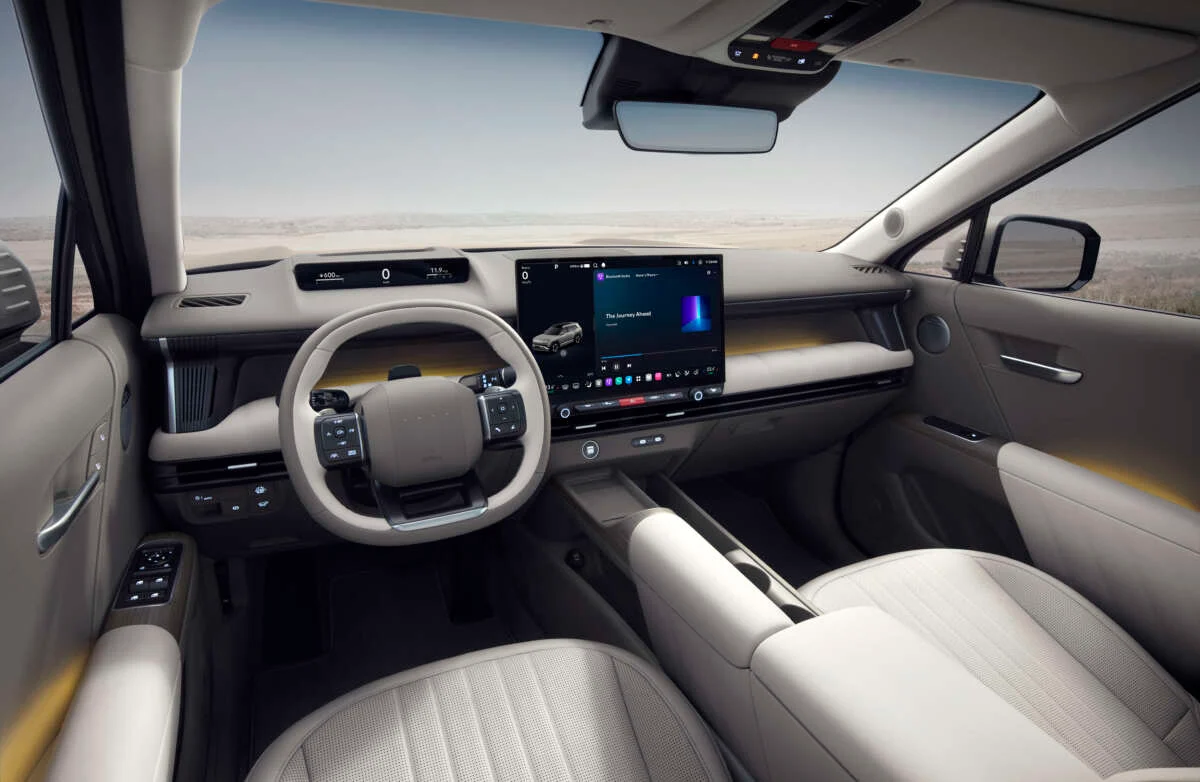
Inside, the Tucson continues the industrial, layered design of the Ioniq 3, with the horizontal upper and lower dashboard appearing to float, separated by a recessed inner panel. The large infotainment touchscreen dominates proceedings, measuring either 12.9 or a whopping 17 inches across and using Hyundai’s new Android Automotive-based Pleos Connect operating system – a first for the US market in particular.
The system enables native integration of third-party apps without smartphone mirroring (you do still get Apple CarPlay and Android Auto), as well as support for three-finger gesture controls and a single-screen mode. Gleo agentic AI voice control is also included.
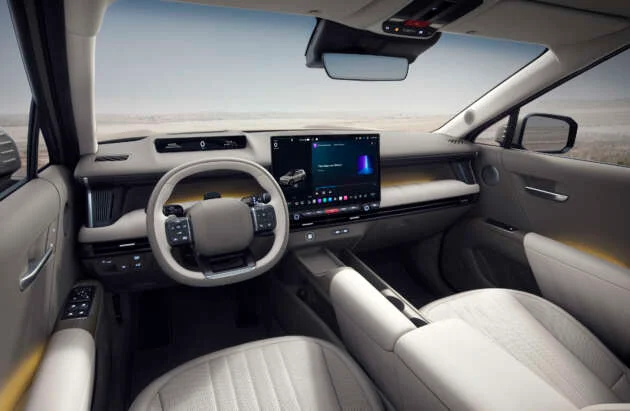
Another benefit of the system is the return of physical air-con, volume and tuner controls to replace some of the old capacitive touch buttons. Meanwhile, the steering wheel has a flat top and bottom to provide an uninterrupted view of the slim 9.9-inch instrument display above it.
Elsewhere, storage space has been increased with a hidden palm rest tray, luggage add-ons and a card holder by the driver’s side air-con vent. As per the Santa Fe, the Tucson gains the option of dual Qi wireless chargers, now of the latest 15-watt Qi2 magnetised variety.
The Tucson also appears to be the first Hyundai to offer Bang & Olufsen branding for its 12 speakers, replacing Bose. Typical of the brand, the front seats get a Relaxation one-touch recline feature, but there’s also a new Ergo Motion Seat option with seven-point massage. The triple-zone auto air con is able to blow air indirectly for a more pleasant experience.


Hyundai claims the increased dimensions provide best-in-class interior space, with rear headroom increasing by 29 mm. The rear doors also open ten degrees wider at 83 degrees to improve entry and egress, while the European model further benefits from 40:20:40 split-folding rear seats. Boot space is 691 litres for the SWB variant and 1,067 litres for the LWB, although the latter is an SAE figure that measures cargo capacity all the way up to the roof.
A total of eight exterior colours will be offered, five of which are new – Serenity White Pearl, Driftwood Grey Matte, Driftwood Grey Metallic, Red Rock Orange Matte, and Goyo Copper Pearl. These are paired with three new two-tone interior colour schemes, these being mud gray and dove grey, black and sand beige, and black with soil brown inlays, in addition to the usual full black.
Safety-wise, the Tucson comes with up to nine airbags (including rear side airbags and a front centre airbag) and Level 2 semi-autonomous driving functionality. The adaptive cruise control now uses navigation data to slow for corners and other road features, and there’s also now a BMW-style reversing assistant and a transparency function for the 360-degree camera system.


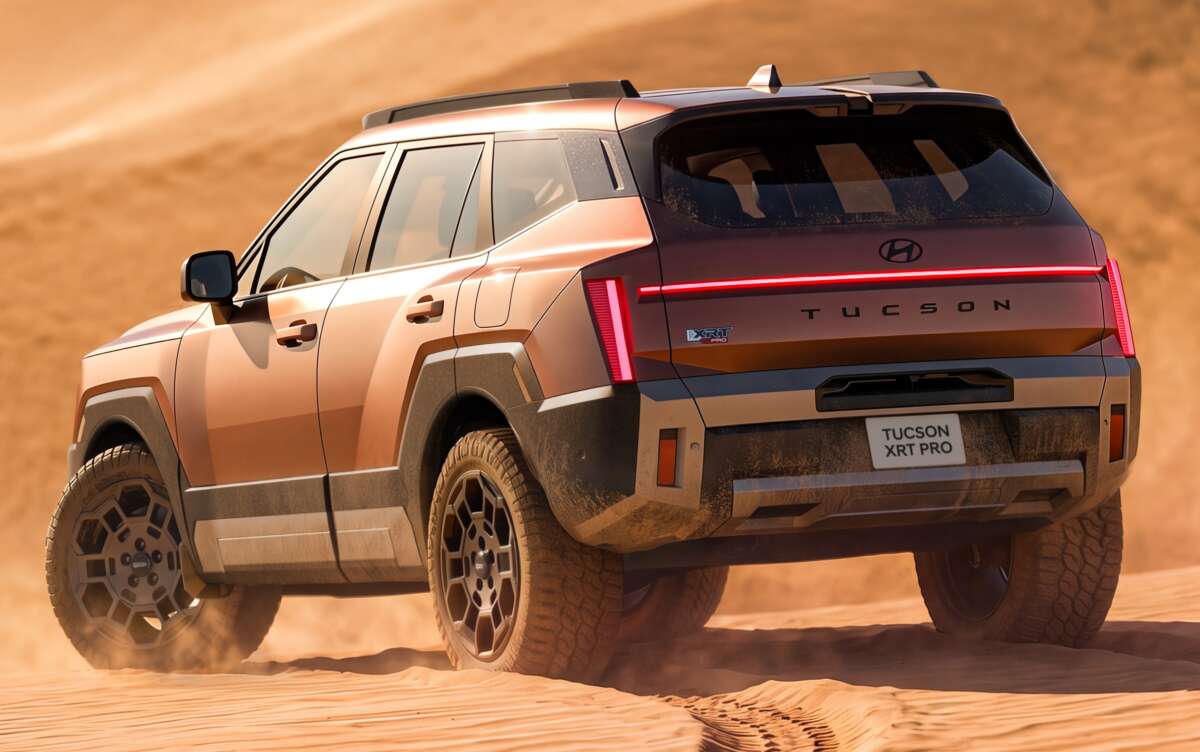
For the second straight generation, Hyundai will offer a rugged XRT package, featuring a bespoke front bumper with a larger grille and skid plate, black wheel arch trims with a forged carbon fibre-like pattern, and a new rear bumper and skid plate, plus black window trim and unique wheel options. Inside, there are patterned seats, dark metal decor, protective floor mats and touch-operated LED tailgate lights.
The fifth-gen model debuts an even tougher XRT Pro variant, only available with AWD. This adds all-terrain tyres, further increased body cladding and front recovery tow hooks, as well as a 30 mm increa in ground clearance to 210 mm.
This trim also adds Smart Terrain Assist, which grades the likelihood of getting stuck based on live wheel slip data and offers low-speed off-road cruise control. On the other end of the spectrum, a sportier on-road-biased model (N Line?) will be revealed at the Paris Motor Show on October 12.






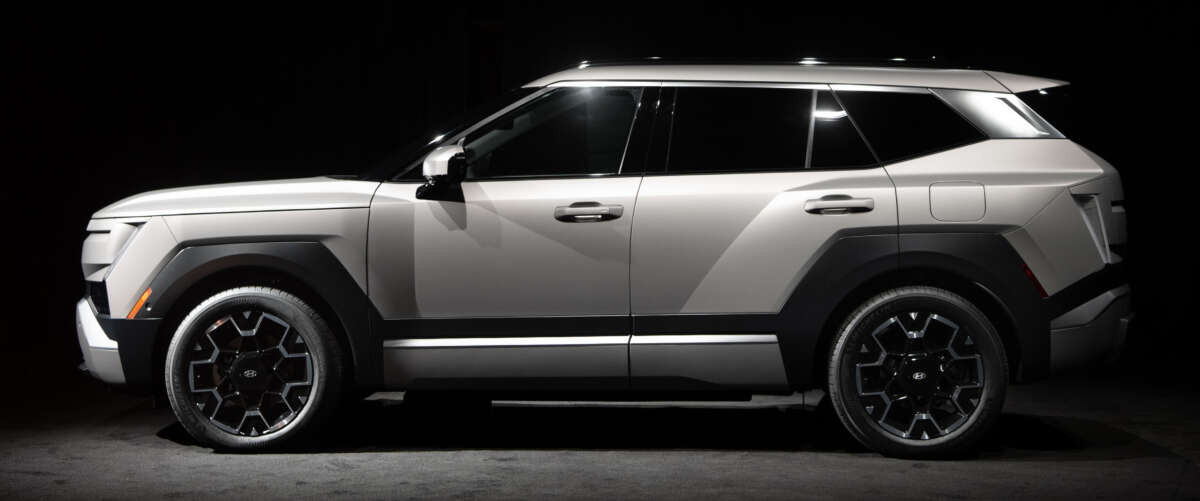


GALLERY: 2027 Hyundai Tucson short wheelbase, Europe


 Hyundai Tucson
from RM159,800
Hyundai Tucson
from RM159,800  Hyundai Stargazer
from RM99,800
Hyundai Stargazer
from RM99,800  Hyundai Ioniq 5 N
from RM443,888
Hyundai Ioniq 5 N
from RM443,888  Hyundai Ioniq 6 N
from RM449,888
Hyundai Ioniq 6 N
from RM449,888  Hyundai Santa Fe
from RM225,000
Hyundai Santa Fe
from RM225,000  Hyundai Staria
from RM179,888
Hyundai Staria
from RM179,888 

What in the 1970s sci-fi prop is this
langgar kerbau pun sedap ni