

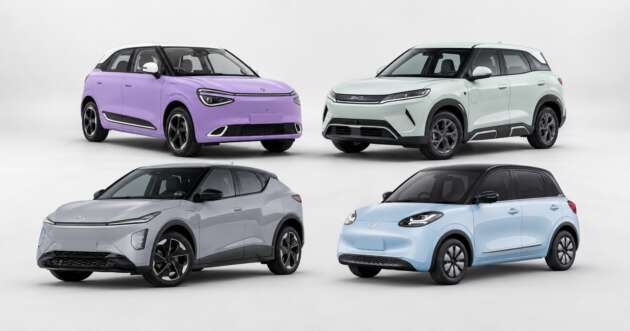
The Proton e.MAS 5 has quickly become the reference point for affordable battery-electric cars in Malaysia. However, it does have what you might consider alternatives present in this market. But who are the rivals and how have they been doing compared to the Proton hatchback? And should you consider any of them if your intention is to buy something different from what everyone else is getting?


Here’s a few EVs that you might consider as rivals to the Proton – BYD‘s Atto 2, the TQ Wuling Bingo brought in by Tan Chong, Perodua‘s QV-E and the Dongfeng Box. Here is how the whole group has been doing through the first seven months of 2026.
The first chart makes the pecking order plain. The eMas 5 pretty much sits is in a class of its own in terms of sales figures. Take the eMas 5 out in the second chart you see above, and the rivals’ own contest comes into focus.
Dongfeng Box
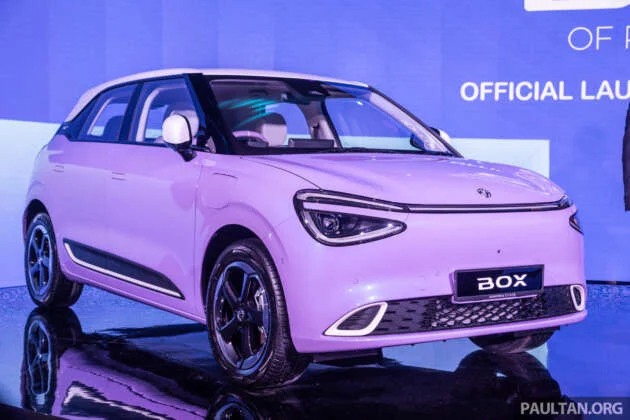
The Dongfeng Box brings up the rear but is still growing month on month. The cutesy hatchback was actually the earliest of this group to market, launched back in November 2024 at RM100,700 to RM113,700 with a 95 PS motor and up to 430 km of CLTC range from its 42.3 kWh battery – pricing that made it a tough sell against similarly-priced, larger rivals.
Dongfeng has since responded the pragmatic way: a RM30,000 promotional discount on limited units brings the Box down to around RM70,000, which transforms the value equation – practical touches like auto parking assist, a 540-degree camera and a ventilated driver’s seat suddenly look generous at that money. At the discounted price, the Box is a pretty interesting left-field pick.
Compare: Proton eMas 5 vs Dongfeng Box
TQ Wuling Bingo
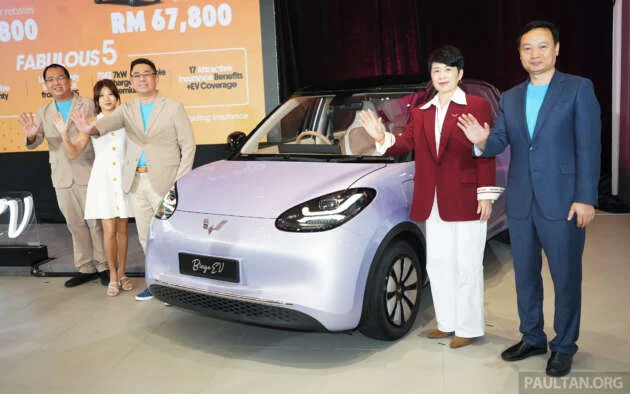
The TQ Wuling Bingo has been the steadiest of the bunch and sits second on 563 units year to date. The little city EV holds a notable distinction – it’s the first EV to be locally assembled by Tan Chong, with CKD production starting at TCMA Segambut in January and the first customer cars delivered in March. Two variants are offered: the Pro with a 31.9 kWh battery (333 km CLTC) and the Max with 37.9 kWh (410 km CLTC), both driven by a modest 68 PS front motor.
List prices are RM67,800 and RM72,800, but a launch package for the first 400 cars knocks RM5,000 off – RM62,800 for the Pro and RM67,800 for the Max – and bundles a 7 kW wallbox. That undercuts the e.MAS 5 range, and the retro-cute styling has its fans. The trade-offs are a leisurely pace, DC charging capped at just 50 kW, and no proper ADAS.
Compare: Proton eMas 5 vs TQ Wuling Bingo
BYD Atto 2

The BYD Atto 2 has pulled clear of the group since spring, climbing to 212 units in July and 875 for the year so far. It’s not hard to see why it leads the chasing pack – the badge helps, as BYD has been Malaysia’s best-selling EV brand, and the Atto 2 is the most conventional “proper car” of the four, a compact SUV that slots between the Dolphin and Atto 3. Launched in July 2025 in a single Premium variant at RM100,000, it packs a 51.13 kWh Blade battery for 345-350 km of WLTP range – the biggest battery in this group bar the QV-E.
The catch is that RM100,000 price, which is eMas 7 territory rather than eMas 5 money. Of course, the RM100k RRP is not so important in a world where pre-reg and used direct owner and demo cars exist. A quick check on classifieds reveals the Atto 2 listed from RM89k from dealers, and around RM77k from direct owners.
Compare: Proton eMas 5 vs BYD Atto 2

Another alternative is the BYD Dolphin, which is a hatchback instead of an SUV. This one isn’t on sale in Malaysia anymore, but used units are still available from RM62k up to RM75k.
The Proton eMas 5’s true rival from BYD is the BYD Seagull (also called Atto 1 or Dolphin mini), sold as the Atto 1 in Thailand and Indonesia but it never quite made it here to Malaysia.
Compare: Proton eMas 5 vs BYD Dolphin
Perodua QV-E
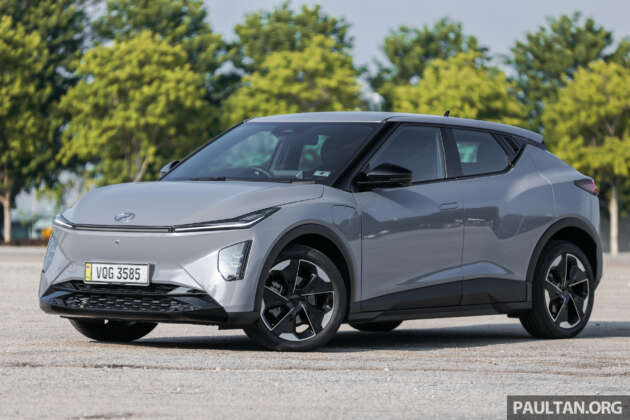
The Perodua QV-E is the fastest climber, going from a single unit in February to 109 in July as supply builds. Malaysia’s first homegrown EV has had an eventful 2026: a localisation push let Perodua cut prices substantially in June, and with the current RM6,500 rebate (running until September 30), the hatchback is yours for RM63,499 with the RM215/month Battery-as-a-Service (BaaS) lease, or RM87,499 to own car and battery outright. Its 52.5 kWh LFP pack – the largest here – delivers 370 km WLTP and a healthy 204 PS.
On paper, then, it’s the closest thing to a direct e.MAS 5 fight: national badge, similar money, more power. The BaaS model is the wildcard – RM215 a month for nine years suits buyers who want battery peace of mind (unlimited mileage, 70% state-of-health guaranteed), but it complicates comparisons with a conventional purchase. Our recent full Malaysian review covers the good and the bad – and with Perodua pushing for volume as localisation completes, expect that sales climb to continue.
Compare: Proton eMas 5 vs Perodua QV-E
AD: Drive the Dongfeng EV of your dreams. Submit your details and Dongfeng Carro (PJ outlet) will get in touch with you.
 Perodua Traz
from RM76,100
Perodua Traz
from RM76,100  Perodua QV-E
from RM69,999
Perodua QV-E
from RM69,999  Perodua Axia
from RM33,900
Perodua Axia
from RM33,900  Perodua Alza
from RM62,500
Perodua Alza
from RM62,500  Perodua Myvi
from RM46,500
Perodua Myvi
from RM46,500  Perodua Ativa
from RM62,500
Perodua Ativa
from RM62,500  Perodua Bezza
from RM34,580
Perodua Bezza
from RM34,580  Perodua Aruz
from RM72,900
Perodua Aruz
from RM72,900 

the QVE is the only car in the group that cannot be sold to others without Perodua’s intervention.
let’s see if and when the Chery Q arrives
If Miti track record speaks for itself.
Chery Q might not even come to our shores or if it does, it’s going to be asked to be priced above average.
these five are very hideous, better fork out more money to buy atto3 or omoda e5, at least look better.
the eMas5 is actually very good looking.
These choices are like the Proton Saga of EV’s, awkward especially to above average sized ppl
Make more eMas7, Atto3 type cars more affordable